

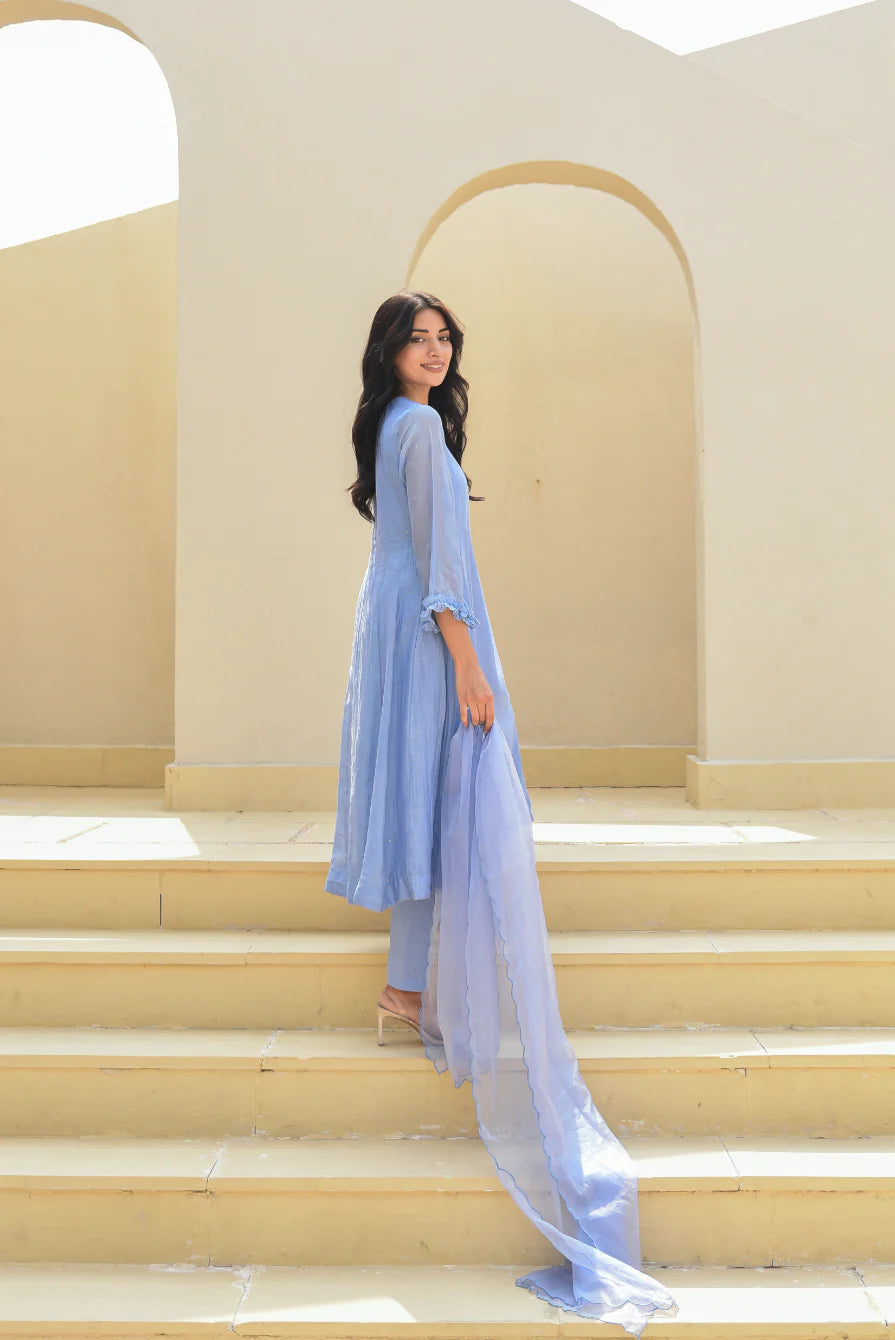
Behind the Seams: The Engineering of the Perfect A-Line Silhouette

Read time: 3 min · Last updated: 2026-01-12
Most people think tailoring is just sewing two pieces of cloth together.
Most people are wrong.
Tailoring is engineering. Especially when you are working with an A-line silhouette and delicate Mukesh work.
At SAROJ JAIN, we don't just "cut and sew." We build.
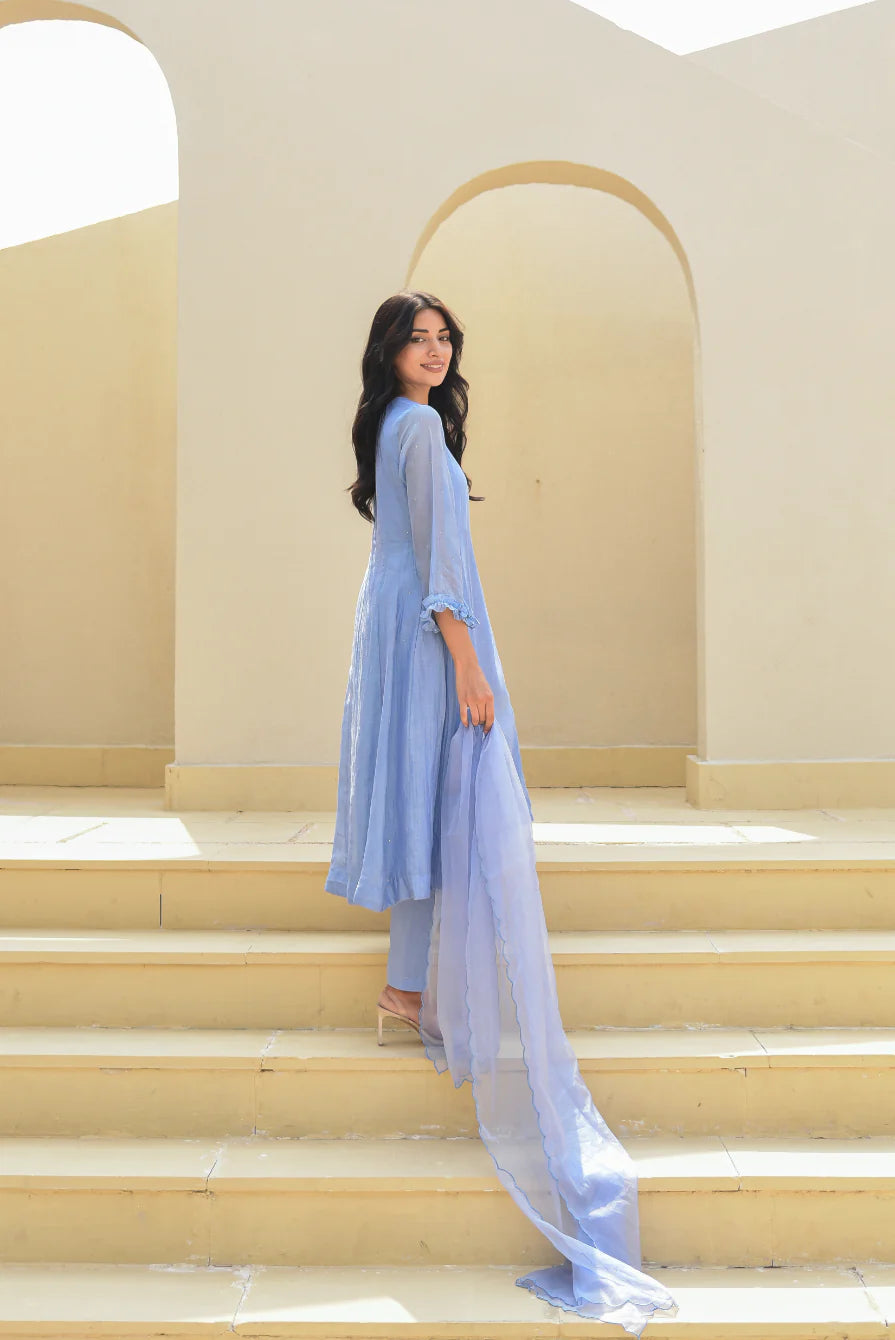
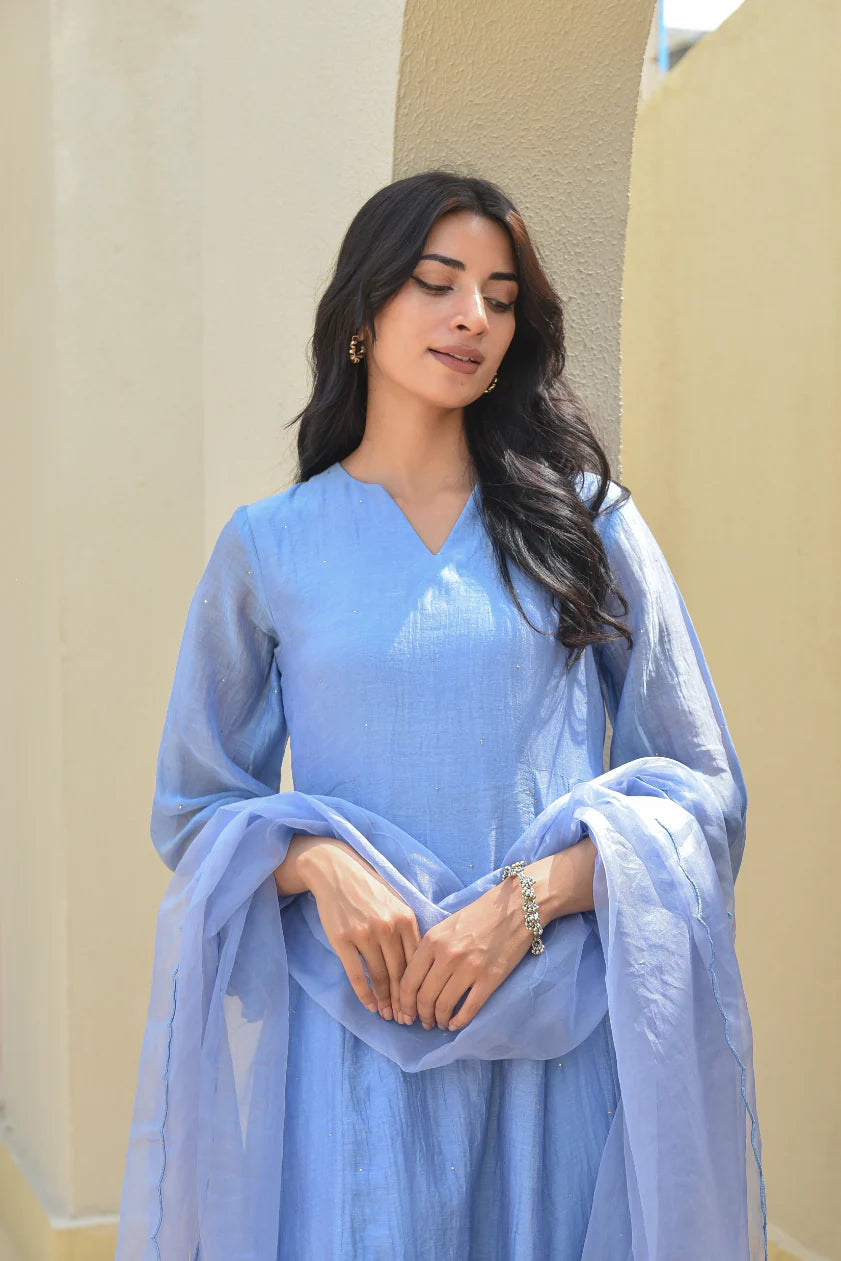
Here is what’s happening "Behind the Seams" of your Ice Blue Mukesh set.
1. The Apex Pivot
The magic of an A-line is where the flare starts. Too high, and you look like you’re wearing a maternity dress. Too low, and it looks like a regular straight suit.
We find the "Apex"—the exact point on the waist—where the fabric should begin its gradual expansion. This pivot is what creates the illusion of a slimmer waist and longer legs.
2. The Weight Balancing Act
Mukesh work is metallic. Wires have weight.
If we don't engineer the seams correctly, the weight of the silver dots will "pull" the fabric down, causing it to sag or lose the A-line shape over time.
We use reinforced internal seams that act like the skeleton of the kurta. They hold the shape so you don't have to.
3. The Hem Taper
A bad A-line hem will "ruffle" or "wave" unevenly. Ours is a perfect, clean circle.
We achieve this through a specific bias-cutting technique that ensures the flare stays uniform from every angle—front, back, and side.
4. The Lining Logic
We don't just throw in a cheap inner slip. Our lining is cut 0.5 inches smaller than the outer kurta.
Why? So you never have that annoying "lining peeking out" at the bottom. And so the outer Mukesh layer always has a smooth, friction-free surface to rest on.
FAQs
Q: Do you use shoulder pads? A: No. We use structured shoulder seams that provide a crisp look without the bulk of old-fashioned pads.
Q: Why does the flare stay so perfect after washing? A: Because we pre-shrink the fabric before cutting. The engineering doesn't change after it hits the water.
Q: Is the stitching visible from the outside? A: We use invisible hem-stitching (interlocking) wherever possible to keep the look as clean as 'Ice.'
Q: Can I get it altered? A: Yes. We leave 2 inches of 'margin' inside every set so you can adjust it if you change size.
Q: How many tailors work on one set? A: Usually two. One master for the cutting, and one artisan for the Mukesh-specific assembly.
Quality isn't an accident. It’s an engineered result.
Shop the Masterpiece → Ice Blue Mukesh Kurta Set
Case Studies
Work-to-Dinner in a Hurry — Gurugram
Neutral co-ord + loafers by day; swap to strappy heels and cuff at night.
Wedding Guest in the Rain — Mumbai
Viscose-blend kurta set with ankle hems and rubber-soled block heels—no drags, clean photos.
Temple Ceremony Minimalism — Chennai
Plain Kanjeevaram-inspired saree, delicate gold, and low bun—elegant and respectful.
Buying Checklist
-
Shoulders clean, bust ease, hem length right for your shoes
-
Breathable lining; test arm movement and sit/stand
-
One neutral piece to mix across outfits
City Notes
-
India: Pick breathable fabrics and repeatable colors.
-
Global: Pick breathable fabrics and repeatable colors.
Ready to build your look? Explore New Arrivals
Related Reads
- The 9-to-9 Hack: How Ice Blue Moves from the Office to the Afterparty
- A-Line Magic: Why This Silhouette is a Game Changer for Your Wardrobe
- The Bridesmaids Code: How to Coordinate with Ice Blue Mukesh
- The 2026 Signature: Why Ice Blue is No Longer Optional
- 400 Years of Evolution: Why Mukesh Work is Still the Peak of Luxury in 2026






Leave a comment
This site is protected by hCaptcha and the hCaptcha Privacy Policy and Terms of Service apply.