

The Manual of Mukesh: How Your Kurta Set is Made (Step-by-Step)

Read time: 3 min · Last updated: 2026-01-12
You look at a kurta. You see "dots."
You think: "That's nice."
I look at that same kurta. I see 40 hours of focused labor. I see broken needles. I see calloused fingertips.
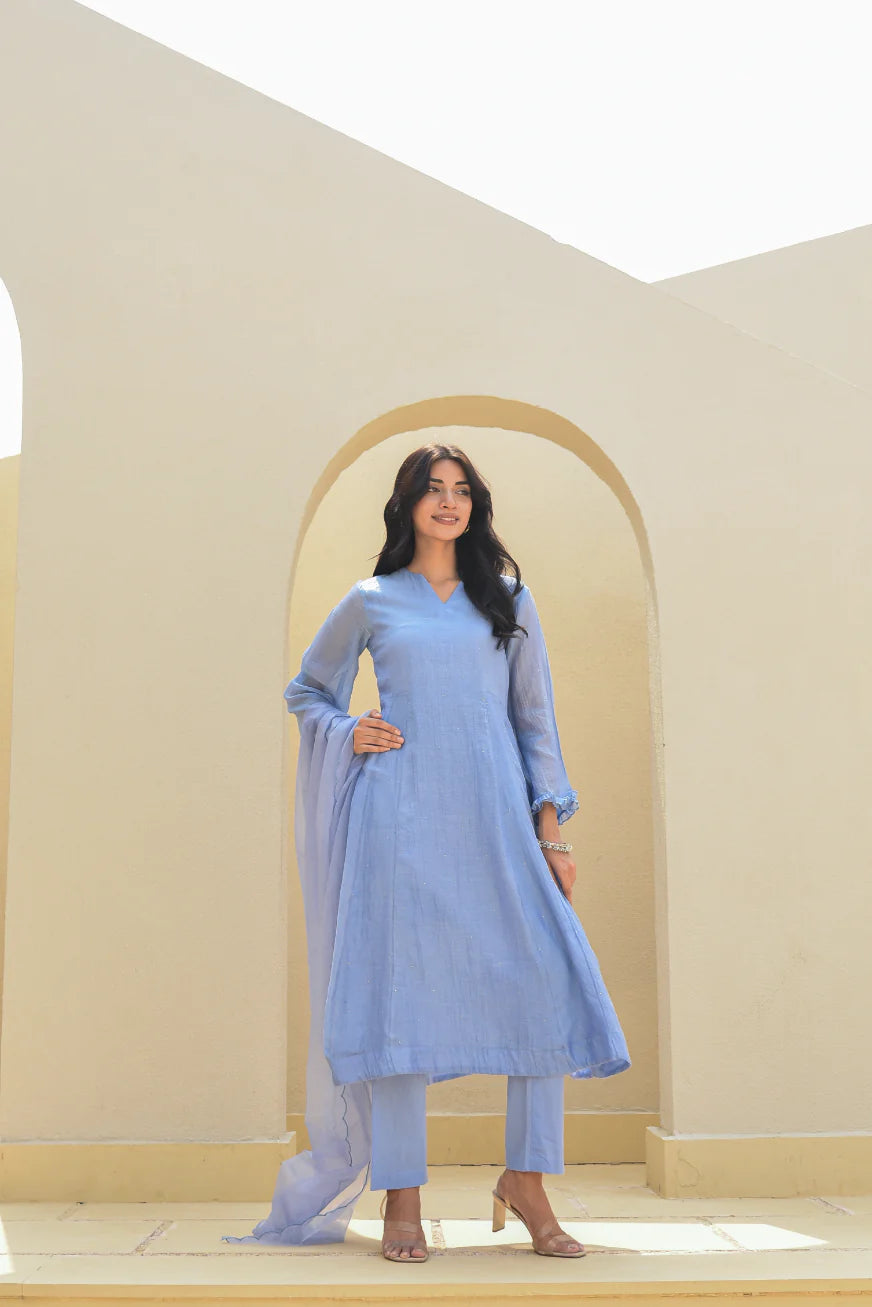
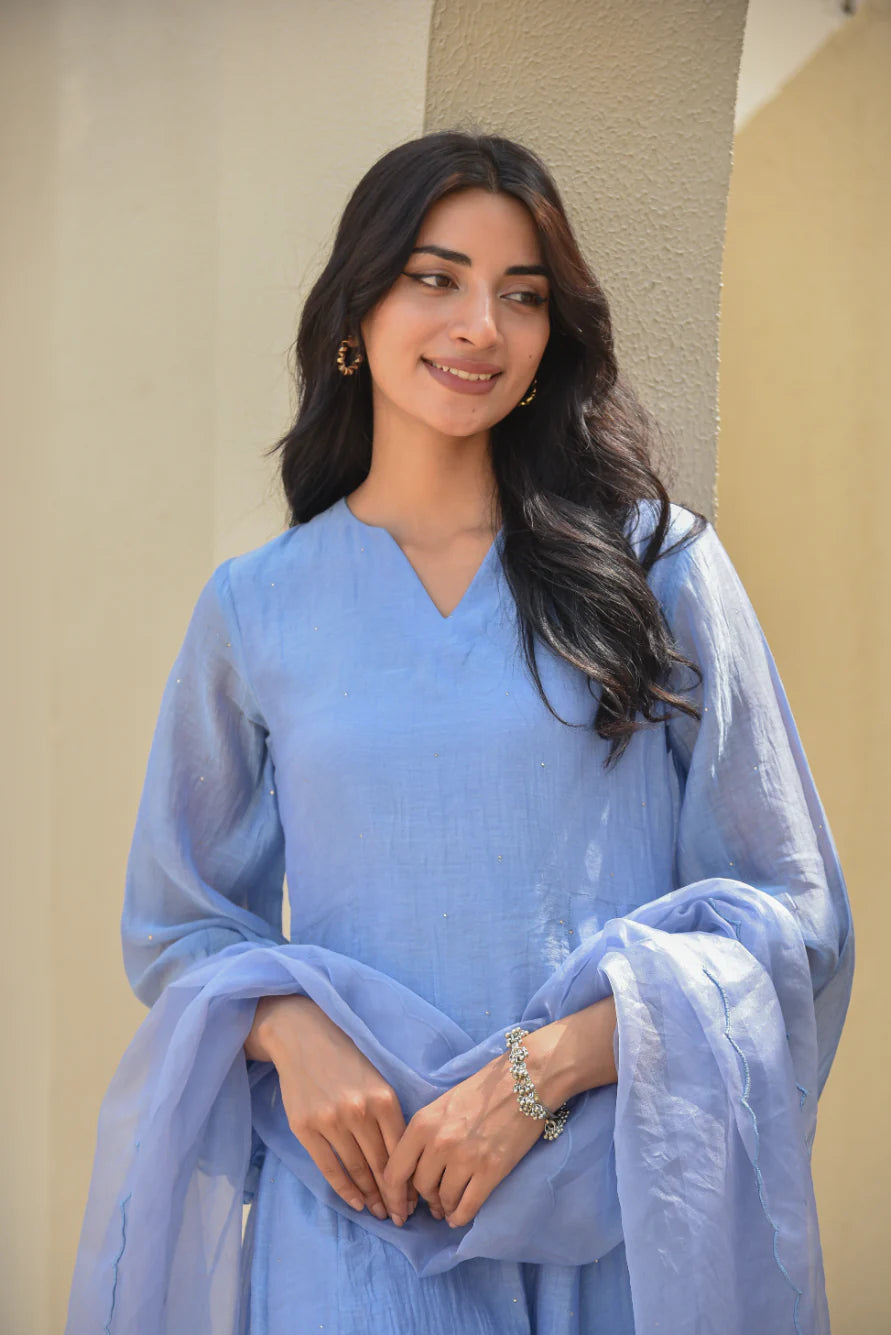
At SAROJ JAIN, we want you to know exactly how your Ice Blue Mukesh A-line set is born.
Because when you know the effort, you own the value.
Here is the "Manual of Mukesh."
Step 1: The Silver Wire Selection
It starts with the metal.
Mukesh isn't thread. It's wire. Usually silver or metallic alloy.
It comes in flat, thin ribbons. Too thick, and it ruins the fabric. Too thin, and it snaps.
We select only the highest grade that retains its sheen even after multiple washes.
Step 2: The Needle Piercing
This is where the magic (and pain) happens.
The artisan makes a tiny hole in the fabric with a needle. He threads the metallic wire through.
It’s like surgery. one millimeter off, and the pattern is ruined.
Step 3: The Twilling
Wait, it doesn't just go through. It has to be "twilled."
The artisan takes the wire and loops it back over itself on the surface of the fabric. He then uses a small wooden mallet or his thumb to flatten it into a "dot."
No glue. No knots. Just the friction and the twill of the metal keeping it in place.
Step 4: The Polishing
Once the kurta is covered in hundreds of dots... It looks dull.
The artisan takes a smooth stone (often a cowrie shell). He rubs it over every single gold or silver dot.
This "burnishes" the metal. That’s why your SAROJ JAIN kurta has that expensive, mirror-like glow.
Step 5: The Finishing
Finally, the fabric is tailored into our signature A-line silhouette.
We ensure the Mukesh work doesn't sit on the seams where it can rub against your skin.
The result? A piece of wearable art.
FAQs
Q: Can I do Mukesh work at home? A: Unless you’ve spent 5 years learning from a master, no. It’s one of the hardest embroidery styles to master.
Q: Is it real silver? A: In our premium sets, we use metallic alloys that replicate the look and durability of silver without the extreme cost that would make the kurta ₹50,000.
Q: Why is Mukesh more expensive than printing? A: Printing takes 2 minutes. One Ice Blue Mukesh set can take an artisan 3 days to complete. You are paying for time.
Q: Does the wire prick the skin? A: Not if handled correctly. The polishing step (Step 4) ensures every dot is flat and smooth.
Q: How do I know it's hand-done? A: Look at the back. Hand-done Mukesh has small irregular twists on the underside. Machine-made (usually fakes) looks too perfect or uses glue.
Respect the craft. Own the legacy.
Shop the Collection → Ice Blue Mukesh Kurta Set
Case Studies
Work-to-Dinner in a Hurry — Gurugram
Neutral co-ord + loafers by day; swap to strappy heels and cuff at night.
Wedding Guest in the Rain — Mumbai
Viscose-blend kurta set with ankle hems and rubber-soled block heels—no drags, clean photos.
Temple Ceremony Minimalism — Chennai
Plain Kanjeevaram-inspired saree, delicate gold, and low bun—elegant and respectful.
Buying Checklist
-
Shoulders clean, bust ease, hem length right for your shoes
-
Breathable lining; test arm movement and sit/stand
-
One neutral piece to mix across outfits
City Notes
- Global: Pick breathable fabrics and repeatable colors.
Ready to build your look? Explore New Arrivals
Related Reads
- The 2026 Signature: Why Ice Blue is No Longer Optional
- 400 Years of Evolution: Why Mukesh Work is Still the Peak of Luxury in 2026
- A-Line vs Anarkali: The Honest Truth About Which One You Should Buy
- The 9-to-9 Hack: How Ice Blue Moves from the Office to the Afterparty
- A-Line Magic: Why This Silhouette is a Game Changer for Your Wardrobe







Leave a comment
This site is protected by hCaptcha and the hCaptcha Privacy Policy and Terms of Service apply.