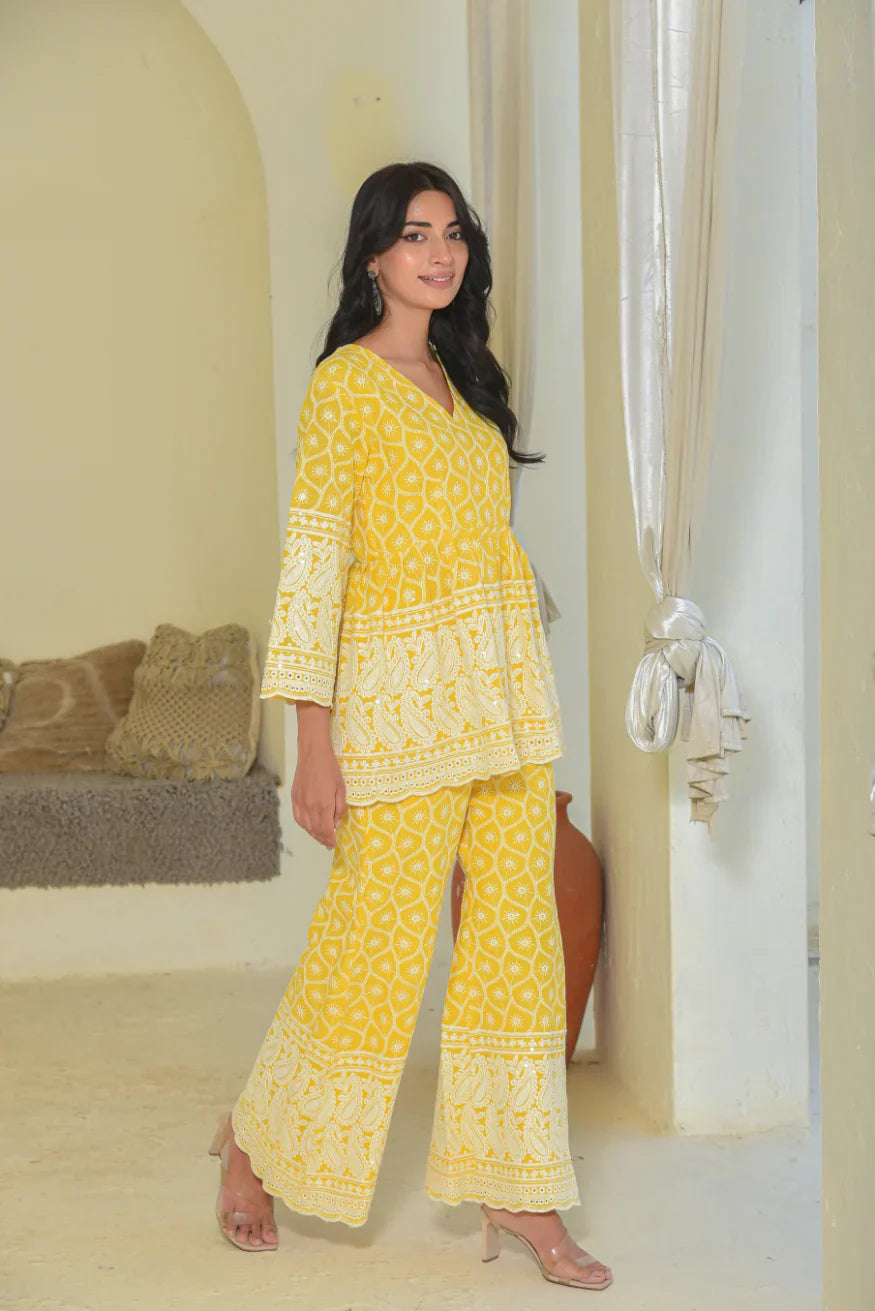

Best Chikankari Style Detail: The Secret Language of Daily Grace
Blog 9: Best Chikankari Style Detail: The Secret Language of Daily Grace
If you think Chikankari is just "embroidery," you are missing the point.
It’s not embroidery. It’s a shadow.
It’s the most sophisticated "stealth" luxury in the world.
I spent a month in the narrow lanes of Aminabad, Lucknow, watching the master artisans work.
I saw women who had been doing this for 40 years.
Their hands moved like they were playing a violin.
No machines. No computers. Just a needle, a thread, and a vision.
In a world of loud, flashy prints and cheap plastic sequins, the best chikankari style is the ultimate statement of grace.
But here is the problem: 90% of what you see on Myntra or at your local boutique is fake.
It’s machine-made garbage that imitates the look but loses the soul.
If you want to own a piece of history, you need to understand the engineering behind the stitch.
Here is the guide to the best chikankari style.
1. The "Bakhiya" Masterclass: The Science of the Shadow
"Bakhiya" is the heart of Chikankari. It’s the shadow stitch.
The artisan stitches on the reverse side of the fabric.
What you see on the front is a soft, blurred shadow of the thread.
It creates a 3D effect without the bulk.
Machine-made "chikankari" just stitches on the front.
It looks flat. It looks cheap. It feels scratchy against your skin.
The best chikankari style is about what you don't see.
It’s about the subtle play of light through the Mulmul cotton.
At SAROJ JAIN, we ensure every "Bakhiya" stitch is uniform and tight.
If the shadow is uneven, the piece is rejected. It’s that simple.
2. The "Jali" Work: The net of Human Patience
"Jali" is when the artisan creates a net-like structure by pulling the threads of the fabric apart.
They don't cut the fabric. They rearrange it.
It’s structural engineering on a microscopic scale.
It creates tiny, perfect holes that breathe.
Machine "jali" is just a laser-cut hole with a zig-zag stitch around it.
It frays after one wash. It looks like a mistake.
True hand-guided Jali work is a testament to human patience.
It takes a master artisan three full days to do a single 4-inch patch of Jali.
That is why it’s an investment. You are buying three days of a human's life.
3. The 32 Stitches of Tradition: A Technical Glossary
Most people only know 2 or 3 stitches. There are 32 distinct stitches in the Lucknowi tradition.
Each one has a name. Each one has a specific "Hand-Speed" requirement.
Murri: The grain-of-rice stitch. It’s a tiny, raised knot. It’s used to create the center of flowers. Phanda: The millet-seed stitch. It’s a larger, more textured knot. It gives the garment its "grip." Tepchi: The basic running stitch. It defines the outlines. If the Tepchi is crooked, the whole piece fails. Hool: The detached eyelet stitch. It’s used for the centers of large leaves. Zanzeera: The chain stitch. It creates the "stem" of the design. Rahet: The pull-thread stitch. It creates a "ladder" effect.
The best chikankari style combines at least 10-12 of these stitches in a single garment.
It creates a "Texture Map" that your eyes can't stop exploring.
It’s the difference between a flat painting and a sculpture.
4. The Story of Salma: A Master of the Shadow
Salma has lived in Lucknow all her life. She is 62 years old.
She started learning Chikankari from her grandmother when she was 8.
She works in a small, sunlit room in a village just outside the city.
She doesn't use a pattern book. She draws the designs with a wooden block and a mixture of indigo and glue.
She told me: "The thread knows where it wants to go. I just help it get there."
When you buy a mass-produced kurta, you are buying a product of a factory.
When you buy a SAROJ JAIN Chikankari set, you are buying Salma’s 50 years of experience.
You are buying her pride. You are buying her dignity.
That is why the best chikankari style can't be rushed.
5. Spotting the "Machine" Fake: The 3-Step Audit
Don't let them lie to you. Use this audit:
1. The Reverse Flip: Turn the kurta inside out. If you see messy, loose threads and long "jumps" between stitches, it’s a machine. If you see clean, interlocking knots and a mirrored pattern, it’s handmade.
2. The Symmetry Trap: Machines are perfect. Humans aren't. In the best chikankari style, you will see tiny, beautiful variations in the size of the stitches. It’s the "fingerprint" of the artisan. If every single flower is 100% identical to the micron, it’s a machine.
3. The Fabric Tension: Machines pull the fabric tight, leaving "puckers" around the embroidery. Handwork is done with a "hoop" that maintains even tension. The fabric around a handmade stitch should be as smooth as a lake.
6. Fabric Comparison: Cotton vs. Silk vs. Georgette
The "Best" Chikankari depends on your context.
Mulmul Cotton: The original. The most breathable. The "Shadow" effect is strongest here. Pure Silk: The luxury version. The thread takes on a natural luster. It’s for high-stakes events. Georgette: The "Swish" version. It drapes beautifully but is harder to stitch. Chanderi: The "Structure" version. The gold zari borders complement the white thread perfectly.
At SAROJ JAIN, we specialize in the 140 GSM Cotton and the Pure Silk variants.
We believe that if you are going to invest in the art, you should invest in the best canvas.
7. The "ROI" of Handmade Art: The Math of Heritage
Let’s talk math.
A machine-made "chikankari" kurta costs 800 rupees.
It’s made of polyester-blend. It pills. The threads come loose. You wear it five times and it looks like a rag.
A SAROJ JAIN handmade Chikankari masterpiece costs 6,000 rupees.
It is an heirloom. You will give it to your daughter.
It actually looks better after 50 washes because the cotton softens and the shadow work "sets" into the fibers.
The "cost per year" of the handmade piece is almost zero.
The "cost per year" of the machine piece is 800 rupees.
Quality is always the cheaper option in the long run.
8. 3 Ways to Style Chikankari for the 2026 Woman
1. The "Executive Fusion": Wear a white-on-white Chikankari kurta with our Graphite Indigo Architectural Trousers. It’s the perfect balance of "Soft Traditional" and "Hard Corporate."
2. The "Denim" Weekend: A short Chikankari tunic with distressed denim and tan leather flats. It’s the "South Kolkata" intellectual look, perfected for a global audience.
3. The "Gala" Evening: A floor-length Chikankari Anarkali with a heavy silk dupatta. You don't need jewelry. The stitches are the jewelry. You are wearing a thousand hours of labor. That is the ultimate luxury.
9. The Care Guide for Heirlooms: Respect the Stitch
If you buy the best chikankari style, you have a responsibility to care for it.
1. Hand Wash Only: Machines are too violent for hand-guided threads. A quick dip in cold water with mild detergent. Don't wring it.
2. The "Shade" Rule: Never hang Chikankari in direct sunlight. The sun eats the delicate threads and fades the "Shadow." Hang it in a cool, breezy spot.
3. The "Reverse Iron": Always iron on the reverse side. It protects the "Murri" and "Phanda" stitches from being flattened by the heat. Keep the 3D texture alive.
10. The Physics of the Shadow: Light Diffraction in Chikankari
Why does the "Bakhiya" stitch look so much better on Mulmul than on silk?
It’s about light diffraction.
Mulmul cotton has a specific thread density that allows light to pass through the gaps in the weave.
When the light hits the shadow thread on the reverse side, it scatters.
It creates a soft "halo" effect around the design.
Silk is too dense. It reflects light off the surface. The shadow is sharper but less "dreamy."
Synthetic fabrics like polyester have a "plastic" sheen that kills the shadow entirely.
At SAROJ JAIN, we select our base fabrics specifically for their "Light-Scattering" properties.
We want the shadow to look like it’s floating inside the fabric, not just sitting under it.
That is the engineering of aesthetics.
5 Ways to Identify an Heirloom Piece
If you are building an investment-grade wardrobe, you need to know what to look for:
1. The "Tapered" Stem: Machine stems are the same thickness from top to bottom. In a handmade piece, the "Zanzeera" stitch tapers as it reaches the end of a leaf. It mimics nature.
2. The "Invisible" Knot: The artisan never makes a knot on the fabric. They weave the tail of the thread back into the stitches. If you see a lump, it’s a shortcut.
3. The "Stitch-per-Inch" Density: Count the stitches in a 1-inch line of "Tepchi." Handwork will have 12-14 stitches. Machine work usually has 6-8. Higher density = higher durability = higher art.
4. The "Block-Print" Ghost: Look for tiny traces of blue indigo ink around the edges. This is the "blueprint" the artisan followed. It’s proof that a human hand guided the needle.
5. The "Weightless" Feel: A fully embroidered handmade Chikankari kurta should feel like a cloud. Machine embroidery uses 3x more thread because it has to "loop" back through the mechanism. It feels heavy and stiff. Handwork is light. Art is light.
Why SAROJ JAIN for Chikankari?
Because I don't buy from middle-men who exploit the artists.
I work directly with the artisan clusters in Lucknow.
I pay them a "Living Wage," not a "Survival Wage."
I give them the time they need to do it right.
Most brands pressure artisans to "hurry up" to meet a Myntra deadline.
That is how quality dies. That is how the art is lost.
I would rather be out of stock for 6 months than sell a piece that isn't a masterpiece.
When you wear SAROJ JAIN, you are wearing a piece of a woman's life.
You are wearing her skill, her history, and her dignity.
The Future of the Stitch: Engineering Tradition
We are engineering new ways to combine Chikankari with modern silhouettes.
We are adding "Hidden Pockets" to hand-embroidered tunics.
We are using VAT-dyed fabrics that don't bleed onto the white threads.
We are taking an 18th-century art form and making it ready for the 21st-century boardroom.
Don't settle for the imitation.
Don't settle for the "vibe."
Demand the art.
Demand the best chikankari style. best chikankari style.