

Best Sharara Set Ideas Under ₹5,000 for Indian Weddings & Festive Events

The Sharara Set Is Having a Moment. Here's Why You Should Already Own One.
There's a reason you've been seeing them everywhere lately. The sharara set is the single most flattering silhouette Indian ethnic wear has produced in the last decade. And the best part, you don't need to spend a fortune to get it right.
A sharara is two pieces that look like one. A fitted top (kurta, anarkali, or crop) that flares out into wide-legged trousers gathered tightly at the knee, then exploding into that dramatic flare below. It's the same principle as a bell-bottom, except the bell has been replaced with a slow, expensive-looking sweep that makes every step feel like a performance.
The problem most women run into is assuming a sharara set only belongs at weddings. That's a waste. The sharara works at office functions, at sangeet nights, at family dinners where you want to look dressed up without looking like you tried too hard. It even works for casual weekends if you pair the right top with the sharara pants and swap heavy juttis for sneakers.
What Makes a Sharara Set Actually Work
Not every sharara set does the job. Some hang wrong. Some make you look wider than you are. The ones that work have three things going for them.
The gathering point. If the sharara pants gather too high on the thigh, they cut your leg at the widest point. That's the mistake. The gathering needs to sit right at the knee. Above that, the pant should be slim. Below that, the flare should be generous but not swimming.
The top length. If the top ends exactly where the sharara flare begins, your torso looks chopped in half. The top needs to extend past the hip, ideally hitting mid-thigh for a kurta or waist-length for a crop. That ratio is what gives the sharara its elongating effect.
The fabric weight. Heavy fabrics drape better on a sharara. Georgette, crepe, and chiffon flow with the flare instead of stiffening it. Cotton works for daytime but flattens the drama that makes a sharara worth buying.
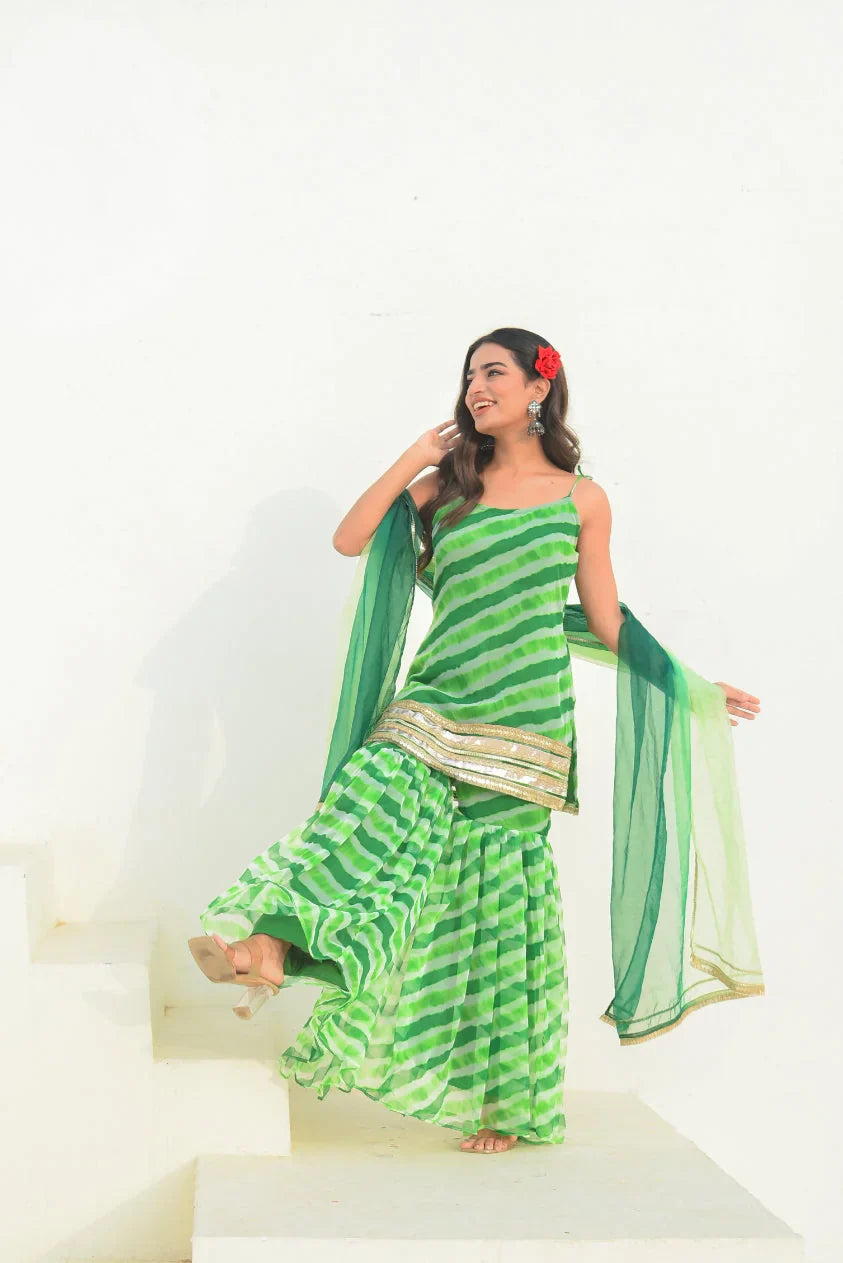
Green Leheriya Kurta Sharara Set — ₹2,499.00
Shop Green Leheriya Kurta Sharara Set →
Orange Leheriya Kurta Sharara Set — ₹2,499.00
Shop Orange Leheriya Kurta Sharara Set →

Peet Amber Sharara Suit Set — ₹3,200.00
Shop Peet Amber Sharara Suit Set →

Teal Blue Kurta Sharara Set — ₹3,500.00
Shop Teal Blue Kurta Sharara Set →

Bottle Green Georgette Sharara Saree Set — ₹3,706.97
Shop Bottle Green Georgette Sharara Saree Set →

Regal Red Georgette Sharara Saree Set — ₹3,706.97
Shop Regal Red Georgette Sharara Saree Set →

Ruby Pink Georgette Sharara Saree Set — ₹3,706.97
Shop Ruby Pink Georgette Sharara Saree Set →

Hot Red Gotta Kurta & Sharara Set — ₹4,500.00
Shop Hot Red Gotta Kurta & Sharara Set →

Leheriya is the tie-dye wave pattern that comes from Rajasthan. It's been around for centuries, so there's nothing costume-y about wearing it when you understand the craft behind it. This set pairs the pattern with a slim kurta top and wide-sharara pants in the same green wash. The fabric is georgette, so it drapes instead of sticking. At ₹2,499 it's the cheapest sharara you'll find at this level of finish.
Best for: Mehendi functions, daytime sangeet, Haldi-adjacent events where you want color without committing to all-yellow.
Style it with: Jhumkas, juttis, no dupatta needed because the kurta is long enough on its own.
Same cut. Same georgette drape. Different wave color. Orange is the sharper of the two leheriya colors. Green reads softer. Orange reads like you made a decision about yourself. If you've been avoiding color in your ethnic wardrobe, this is the entry point.
Best for: Festival functions, dandiya nights, any event where you want to be the first person someone notices.
Style it with: Gold jhumkas, block heels (not stilettos), minimal nails.
This one doesn't chase a pattern. It relies on the silhouette doing all the work. The color is a muted amber, close to sandstone, which makes it one of the most versatile pieces in the sharara category. You can wear it to three different functions and no one will ask why you're wearing the same thing.
Best for: Wedding guest who doesn't want to compete with the bride's family colors. Office Diwali parties. Mother-of-the-bride-adjacent events.
Style it with: Statement necklace, pointed heels, a small clutch.
Teal is the color that bridges formal and festive. It's darker than blue but lighter than black, which means it photographs well under any lighting and survives both daylight and ballroom. The kurta here has a clean A-line cut that flatters every body type because it doesn't cling at the waist and doesn't swallow the figure.
Best for: Reception guests, engagement parties, any function where the dress code sits between formal and fancy.
Style it with: Drop earrings, pointed-toe flats or block heels, a structured clutch.
This is where things get interesting. It's labeled a Sharara Saree Set because the dupatta is cut longer and wider than a standard one, meant to be draped like a saree pallu over the sharara set. The fabric is georgette throughout, and bottle green is one of those colors that looks expensive no matter the price point. The flare on the sharara pants is generous enough to show movement but controlled enough to not trip you.
Best for: Evening receptions, cocktail functions, any event with warm lighting where jewel tones thrive.
Style it with: Heavy jhumkas, kadas, a small potli. Skip the dupatta if the function is dance-heavy.
Red is a loaded color in Indian weddings because it traditionally belongs to the bride. The fix is in the shade. This isn't bridal red. It's a deeper, more muted red that reads regal rather than ceremonial. Pair it with gold or oxidized silver instead of the rose-gold that signals bridal.
Best for: You're the wedding guest who decided to skip beige and embrace color responsibly. Sangeet nights where red is appropriate but not expected.
Style it with: Oxidized silver jhumkas, a bindi that's slightly off-center. This is the subtle rebellion that reads as intentional.
Pink in ethnic wear usually lands somewhere between girlhood and bridesmaid. This ruby shade sidesteps both because it's saturated enough to be serious but warm enough to feel festive. The sharara flare gives it structure that plain pink dresses lack.
Best for: Engagement functions, post-wedding brunches, any event where you want to look put together without looking armored.
Style it with: Delicate necklace (the kurta neckline carries weight), hoop earrings, nude or ruby polish.
This is the most dressed-up option in the list. Gotta patti, the thin metallic ribbon stitched along seams, adds a line of shimmer that turns a solid red into something that catches light when you move. It's the difference between wearing red and being seen in red. The sharara flare on this one sits slightly wider than the others, which is why it's the most expensive at ₹4,500. The craftsmanship justifies the price.
Best for: The last function of the wedding season when you're tired but still want to look good. The one where you don't want to think about what to wear and just reach for something that works.
Style it with: Minimal jewelry. The gotta patti is already talking. Let it.
The Sharara Survival Guide
A few things that matter once you buy the set.
Footwear. Stilettos sink into grass. Pointed flats are better for outdoor functions. For indoor marble or tile floors, block heels give you height without the ankle gamble. Juttis work if the sharara hem doesn't drag on the ground. If it drags, go with flats.
Dupatta strategy. If the set comes with one, pin it at the shoulder. Unpinned dupattas on sharara sets tend to catch on chairs, get dragged across floors, and end up in food. A dupatta pin costs ₹20 and saves you from an embarrassment that lasts six months.
The sitting test. Before you commit to a sharara for any event, sit down in it. If the pants pull up past your knees and expose more leg than you're comfortable with, the flare is too tight at the gathering point. Exchange it. No one wants to spend an event tugging at their pants.
After-care. Georgette can go in the wash on gentle cycle with cold water. Hang dry. Iron on reverse side at low heat. If the set has gotta patti or heavy embroidery, dry clean. The ₹200 dry-cleaning bill is cheaper than replacing a ₹4,000 set because you tried to save ₹200.
Why These Prices Make Sense
A sharara set involves twice the fabric of a kurta set. The pants require extra cutting, extra stitching at the gathering point, and often a different fabric weight than the top. The artisans who make these sets work across two silhouettes instead of one. The price reflects that. At ₹2,499 to ₹4,500, these sets underprice what you'd pay at a mall boutique for similar finish. Direct-from-artisan sourcing is what keeps the prices honest.
Where to Start
If you've never worn a sharara before, begin with the Green Leheriya or Orange Leheriya at ₹2,499. They're forgiving colors, proven patterns, and georgette fabric that moves with you. You'll wear it once and wonder why you waited.
If you want something you can rotate across three functions without repeating, go with the Peet Amber at ₹3,200. It's the sharara equivalent of a white shirt, unexciting on paper, indispensable in practice.
If you want to look like you planned this weeks in advance, grab the Hot Red Gotta at ₹4,500. It's the sharara set that stops conversations mid-sentence.