

Mehendi Function Dress Code And Outfit Styling
Updated: August 2026 | Written by: Saroj Jain Styling Team | Reviewed by: Saroj Jain Boutique Team
Most guests get the mehendi function dress code and outfit styling wrong in the same way. They dress for photographs and forget they will be sitting on the floor with wet henna on both hands.
We watch this happen every wedding season at our JP Nagar 5th Phase store. A guest walks in wanting "something green, not too plain", then comes back three days later to say the dupatta touched her palm within ten minutes of the artist starting.
This guide fixes that. Colours, sleeves, hems, silhouettes and fabrics, sorted by what actually happens at a real mehendi.
Quick answer: Wear a mid-length outfit in mint, sage, lime, mustard, peach, coral or pastel. Keep sleeves at the elbow or roll them up. Pin the dupatta behind the shoulders, never over the arms. Choose a soft cotton, chanderi, cotton-silk or georgette with a hem you can lift for feet henna. Skip the floor-length trailing Anarkali, the stiff can-can lehenga and the heavy bridal emerald.
What This Dress Code Really Means in 2026
The mehendi function dress code is not formal and not party. It sits in the middle: festive, colourful, easy to move in.
Think of it as a daytime garden function with a floor. You will sit cross-legged, hold a cup of chai awkwardly, lean in for group photos, and stand up again without using your palms.
Guests who read the code correctly look bright in photos and calm in person. Guests who read it as "wedding guest outfit" end up tugging at a dupatta and worrying about a hem all evening.
Colour Rules: Green, Yellow, Pink, Orange, Pastel
Green is the default for a reason. Mehendi, leaves, turmeric and marigold sit in that palette.
But emerald and bottle green with dense gold work is often what the bride wears. Guests should stay in the lighter branch of the family: mint, sage, lime, olive, sea green, or a green floral print.
Yellow and mustard are the safest cheerful choices. Avoid a yellow so close to haldi yellow that you look like you are at the wrong ceremony.
Pink, coral, peach and orange work beautifully in daylight. Sunkissed tones photograph warm without looking heavy.
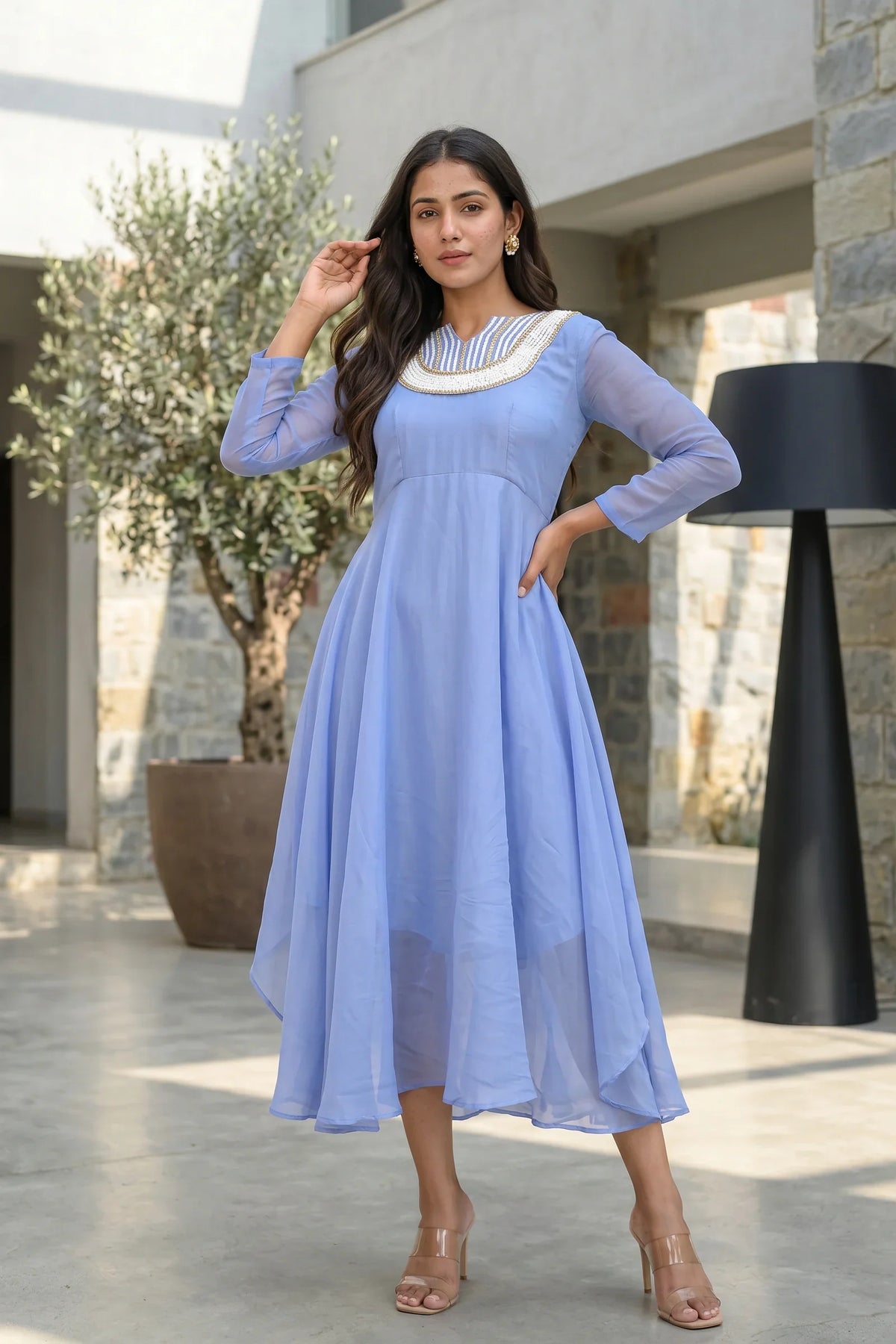
Pastels (powder blue, lilac, pale mint, blush) are the most modern option and are excellent for outdoor afternoon mehendis.
Two colours to handle with care: pure white, because henna stains show immediately, and full bridal red, because it belongs to the wedding day.
Sleeves, Cuffs and Dupattas: Keeping Wet Henna Off Fabric
This is the part most style blogs skip. Wet henna ruins a light dupatta faster than any other fabric on the outfit.
Our first store observation: nearly every second customer who tries on an Anarkali here immediately asks, "will the elbow sleeve come in the way of the mehendi?" It is a real concern, not fussiness.
Best sleeve lengths: elbow-length, three-quarter, or full sleeve with a cuff that rolls up cleanly to the elbow.
Avoid: flared bell sleeves, heavy embroidered cuffs, and flutter sleeves that hang open near the wrist.
Dupatta rule: drape it on one shoulder and pin the loose end behind your back, or wear it as a bandhgala-style drape. Never let it hang forward over both arms.
Cuff trick: ask the artist for a paper cuff or clear plastic cuff before they begin. It keeps the cone off your bangles and off the sleeve edge.
Jewellery: skip a stack of bangles on the day. Wear one kada or a single bracelet on the hand that is not being worked on, and let mehendi be the ornament.
Hems You Can Lift: Feet Henna Practicality
Feet henna usually happens after the hands, once you are already seated and settled. That is exactly when a tight or long hem becomes a problem.
Look for a hem with slack. A flared palazzo with two inches of extra length, a sharara, or a kurta that ends just above the ankle all let you lift and hold fabric with one hand.
Our second store observation: customers who choose a floor-touching Anarkali for the mehendi are the ones who come back saying the hem picked up colour from the floor decorations. Floor-length does mean henna risk, it means venue risk.
If you love a long silhouette, pick one with a gathered hem so you can hold it up in a single bunch.
Seated Comfort by Silhouette
Cross-legged sitting for two to three hours is the real test. Here is how each silhouette behaves.
Sharara: the best all-rounder. Wide leg with plenty of hip room, and the short kurta top does not bunch at the knee.
Palazzo with kurti: easiest to sit in and easiest to wash. Pick a flat elastic or drawstring waistband, not a tight hook closure.
A-line Anarkali: strong choice if the flare starts at the bust or empire line. Flare that starts at the waist will fold and crease across your lap.
Gharara: beautiful, but the heavy knee joint can feel tight after an hour on the floor. Keep it for the shorter functions.
Lehenga: only if the can-can is soft or removable. A stiff lehenga does not sit cross-legged, it perches.
Straight kurti with cigarette pants: fine for a home mehendi, less comfortable over long hours because the waistband digs when seated.
Fabric Guide for Indian Venues, Heat and Daylight Photos
"Lightweight" is not enough. Two light fabrics behave very differently in a Bengaluru November courtyard.
Mul cotton: the most breathable option and the kindest to skin in heat. It creases across the lap, so pick a print that hides folds.
Khadi and cotton-silk: hold shape and resist creasing. Cotton-silk is our usual recommendation for guests who want structure without weight.
Chanderi: light, slightly translucent, and glows in natural light. Excellent for afternoon photos, but creases sharply. Wear it for a two-hour function, not a five-hour one.
Georgette: drapes beautifully and photographs well, but traps heat and snags easily on henna cones and chair edges. Best for evening mehendis.
Linen: crisp and cool, but wrinkles hard and shows henna smudges. Choose a darker tone if you go linen.
Satin: good for a stylised, modern mehendi with indoor lighting. It shows every water mark, so keep it away from the henna station.
Our third store observation: on a 2 pm Bengaluru trial, customers in cotton-silk stay comfortable through the fitting. Customers in heavy net start fanning themselves within fifteen minutes. Fabric decides your mood at hour three.
Guest, Family, Bride's Sister: Dressing the Scale
Guest: one festive element. A print, a border, or a light dupatta. Keep work minimal so you do not read as part of the bridal party.
Close friend or colleague: add a second element. Embroidered yoke, mirror work, or a contrast dupatta.
Cousin or sister of the bride: one step below the bride. Mid-weight work, coordinated family colour, no full zari or stone.
Mother of the bride or groom: richer fabric, deeper colour, and a silhouette she can sit in comfortably for hours. Comfort outranks drama here.
Four Saroj Jain Picks We Keep Recommending
These four cover most of the mehendi briefs we get at the store, from "something breezy" to "family function, but not bridal".
Saroj Jain pick: Emerald Green Heavy Work Anarkali Dress With Dupatta

Price: ₹6,676.89
Why it works: the deep green reads festive without needing bright light, and the Anarkali flare gives you hip room while seated. It is the strongest pick for a family member who needs presence in photographs.
Best for: the bride's sister, cousin or a family function with a photographer present.
Style with: one statement jhumka and a thin gold kada. Keep the dupatta pinned behind the shoulders so your forearms stay free.
Avoid if: you are a guest at a mehendi where the bride is in emerald. Choose mint or mustard instead.
Shop the Emerald Green Heavy Work Anarkali Dress With Dupatta
Saroj Jain pick: Cut Work Kurti

Price: ₹3,560.49
Why it works: cut work gives you festive detail without weight, and a kurti this length pairs with palazzos for easy floor sitting. It is the piece we suggest to guests who want to look dressed but stay mobile.
Best for: a daytime home mehendi, a courtyard
Visit the Saroj Jain Boutique
Discover our collections in person.
57/1, 1st Cross Rd, opposite to Iyengar's Bakery, Dollar Layout, J. P. Nagar Phase 5,Bengaluru, Karnataka 560078
+91-9314078524