
Pre-Draped Sarees And Modern Drapes
Updated: August 2026 | Written by: Saroj Jain Styling Team | Reviewed by: Saroj Jain Boutique Team
Pre-draped sarees and modern drapes solve a very specific Bangalore problem: you have forty minutes, the cab is at the gate, and pinning six pleats by hand is not happening. In our JP Nagar 5th Phase fitting room, almost every woman asks the same thing. Will the stitched version look like a saree, or like a costume? The answer comes down to three measurements and one fabric decision. Height to heel, waist ease, and pallu drop decide how the drape sits on your body. Fabric decides whether the pleats behave. Here is how we actually fit these pieces, what we see go wrong at the trial mirror, and which options survive a real evening.
Quick Answer: A pre-draped saree works only when it is cut to your heel height and your waist ease. Ask for a hem measured with your actual footwear, a two inch waist allowance, a concealed side zip, and a pallu that can be moved once. Choose crepe or soft georgette for long functions where you will sit. Choose satin or tissue for short receptions and photographs. Organza holds pleats stiffly and tents at the knee when you sit cross-legged, so test that before you buy.
- Why pre-stitched sarees became the Bangalore default
- Heel height engineering: the measurement nobody asks about
- Fabric pleat behaviour: georgette, crepe, satin, organza, tissue
- Security versus flexibility: zips, hooks, lining, belts
- Fit across heights, waist measurements and body types
- Can you restyle the pallu after buying?
- The real stress test: sitting, dancing, restroom, travel
- Which fabric reads elegant in daytime photographs
- Saroj Jain picks from our JP Nagar racks
- Comparison table
- Body type and silhouette matrix
- What to avoid
- Questions we answer at the counter
Why pre-stitched sarees became the Bangalore default
Most of our customers are not first time saree wearers. They are women who already own six sarees and cannot drape one in under twenty five minutes with a toddler in the room.
Ready-to-wear sarees cut out the guesswork on pleat depth and pallu width. That is the actual value. Not the stitching. The repeatability.
Boutique observation: women who buy a pre-draped saree once usually come back for a second in a different fabric, not a different colour. They have already solved the fit problem and only want the look to change.
Heel height engineering: the measurement nobody asks about
This is the gap in most online listings. The hem is the drape.
We keep a pair of three inch block heels and a pair of flat sandals in the trial room. Nine out of ten women try the saree with flats first, then admit their event footwear is a heel.
A hem cut for flats sitting on a three inch heel lifts the front pleats too high and exposes the ankle. A hem cut for heels worn with flats drags on the JP Nagar pavement and wears out in one evening.
Ask for the hem to be measured with the exact footwear on. If you plan to change from heels to flats between the ceremony and dinner, keep an extra one inch of drop and get the pleats lightly tacked, not sealed.
Boutique observation: the sarees that come back for alteration almost always come back one week after a wedding, dragging at the front left corner. That is a heel mismatch, not a stitching fault.
Fabric pleat behaviour: georgette, crepe, satin, organza, tissue
Fabric decides movement. Colour decides nothing.
Georgette and crepe fall fluidly and hold soft pleats through sitting, dancing and a long dinner. They forgive a slightly imperfect pleat line.
Satin holds a sharp, polished line and photographs beautifully at a reception. It also slips, so it needs a firmer waist hook and a proper lining.
Organza keeps pleats standing up. That reads dramatic in a photograph and stiff in real life. It also tents at the knee the moment you sit down.
Tissue and handwoven blends hold a crisp edge without much body. They crease visibly at the lap after twenty minutes of sitting.
Match the fabric to the movement, not the moodboard. A sangeet with three hours of dancing needs georgette. A 40 minute reception needs satin.
Security versus flexibility: zips, hooks, lining, belts
Every extra stitch buys stability and costs comfort. That trade is the whole design decision.
A concealed side seam zip with a waist hook does more for hold than stitching the pleats flat. Stitched-flat pleats look neat standing and restrict you the moment you sit.
Ask where the closure sits. A zip at the side seam lets you breathe and use the restroom independently. A back zip with a sealed waistband is faster to wear and harder to manage later in the evening.
Lining and underskirts prevent show-through, especially in tissue and light georgette under Bangalore daylight. Ask for a cotton lining if you will be in the outfit for more than four hours.
A slim belt at the waist is a practical alternative to tight stitching. It holds the drape and lets you loosen it after dinner.
Fit across heights, waist measurements and body types
Pre-draped sarees are not one size. They are one pattern stitched to a range, which is why height adjustment matters most.
Under 5 feet 2: ask for a shorter pallu drop and a pleat line that starts higher. A long pallu on a petite frame drags the silhouette down.
Above 5 feet 7: ask for extra length in the pleat panel, not just the hem. The front fall needs to reach the floor at your heel height, not hover.
Waist measurements change. Keep two inches of ease built in so the drape survives a festive dinner and a heavier blouse.
Curvy figures benefit from a pleat panel that is slightly wider and a pallu that falls from the shoulder rather than the arm. Lean frames look better with a narrower pleat stack and a softer fabric.
Can you restyle the pallu after buying?
Ask this question out loud before you pay. Most listings never mention it.
A pallu attached at the shoulder seam with a hook and one light tack stitch can be moved once or twice. That gives you a second look for a second function.
A pallu stitched flat across the bodice with a decorative pin point is one look only. That is fine for a single reception, less useful for a wedding with three events.
If you want a saree gown or drape gown effect, ask for a pallu that can be pinned over the shoulder or left as a cowl. That single adjustment changes the entire silhouette.
The real stress test: sitting, dancing, restroom, travel
Every saree we sell gets the same in store test. Sit down cross-legged on the trial room bench and stay there for two minutes.
Boutique observation: this is the test that kills organza and confirmations alike. If the front pleat panel tents at the knee, it will look worse at a muhurtham.
Then walk the length of the store. Check whether the pleats move away from the waistband and whether the pallu slips off the shoulder.
For travel, fold the saree along the pleat lines only. Rolling it flattens the stitched edge and you will spend the first hour of the function pressing it back into shape.
Which fabric reads elegant in daytime photographs
Bangalore daylight is hard on shine. Satin and heavy tissue reflect it and can read flat on camera at 11 am.
Crepe and soft georgette absorb light and show fold lines, which is what makes a saree look like a saree in a photograph.
For an evening reception under warm light, satin and tissue come back into their own. Choose the fabric for the light you will be photographed in, not the light in the shop.
Saroj Jain picks from our JP Nagar racks
These are pieces we hand women when they want a drape look without a stitching decision, or a practical alternative for a function where a full saree is not workable.
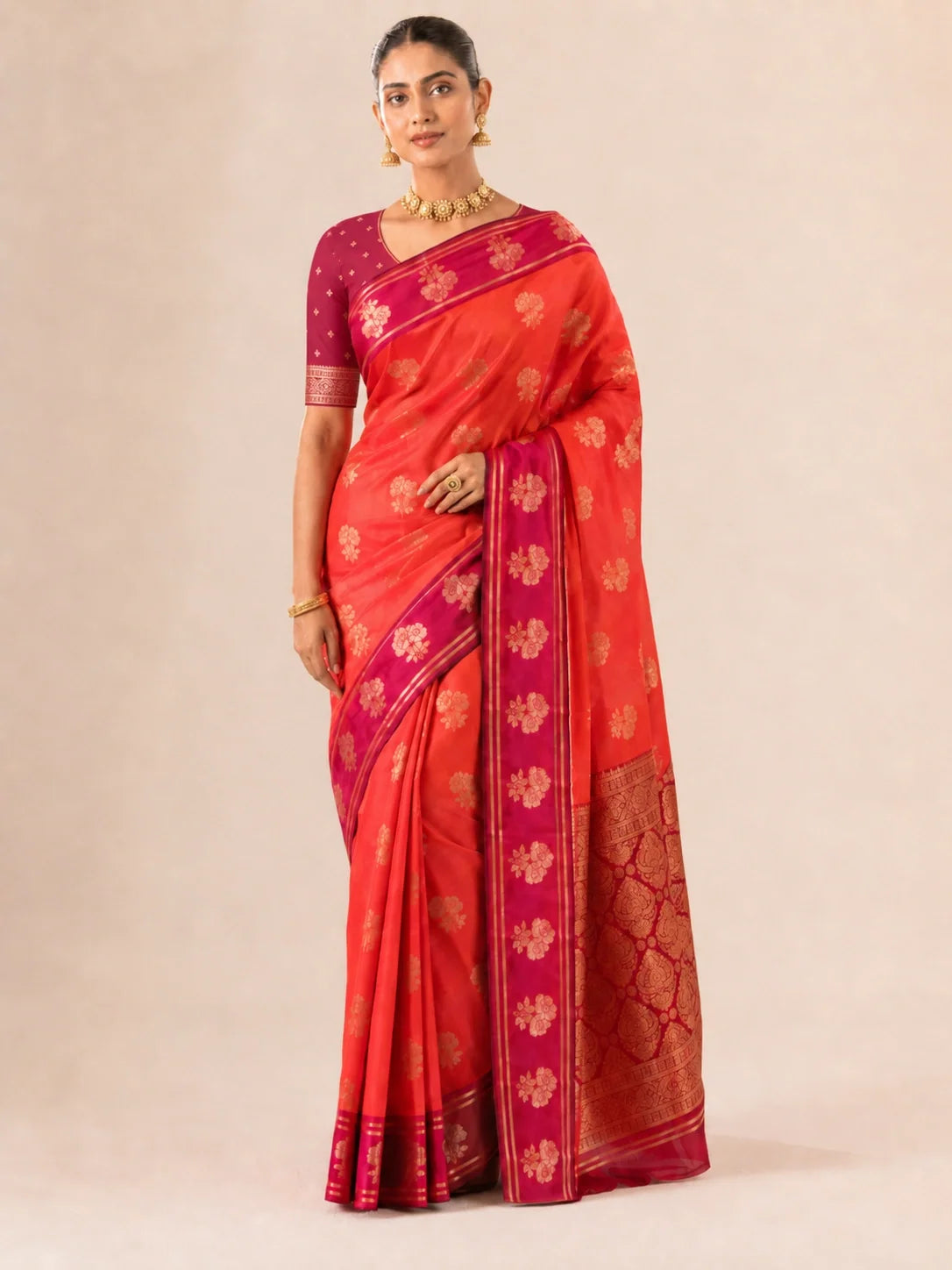
Saroj Jain pick: Scarlet Radiance Handwoven Tissue Fusion Saree (With Rich Fuchsia Woven Blouse)

Price: ₹946.05
Why it works: Handwoven tissue holds a crisp pleat line without added weight, so a pre-stitched pleat panel stays sharp instead of collapsing. The fuchsia blouse does the colour work so the drape can stay simple.
Best for: A reception or an evening engagement where you will be standing and photographed for two to three hours.
Style with: A slim gold waist belt over the pleat line and block heels. Keep the jewellery to one statement piece at the ear.
Avoid if: You will be sitting cross-legged on the floor for a long muhurtham. Tissue creases at the lap and the crease will stay.
Shop the Scarlet Radiance Handwoven Tissue Fusion Saree
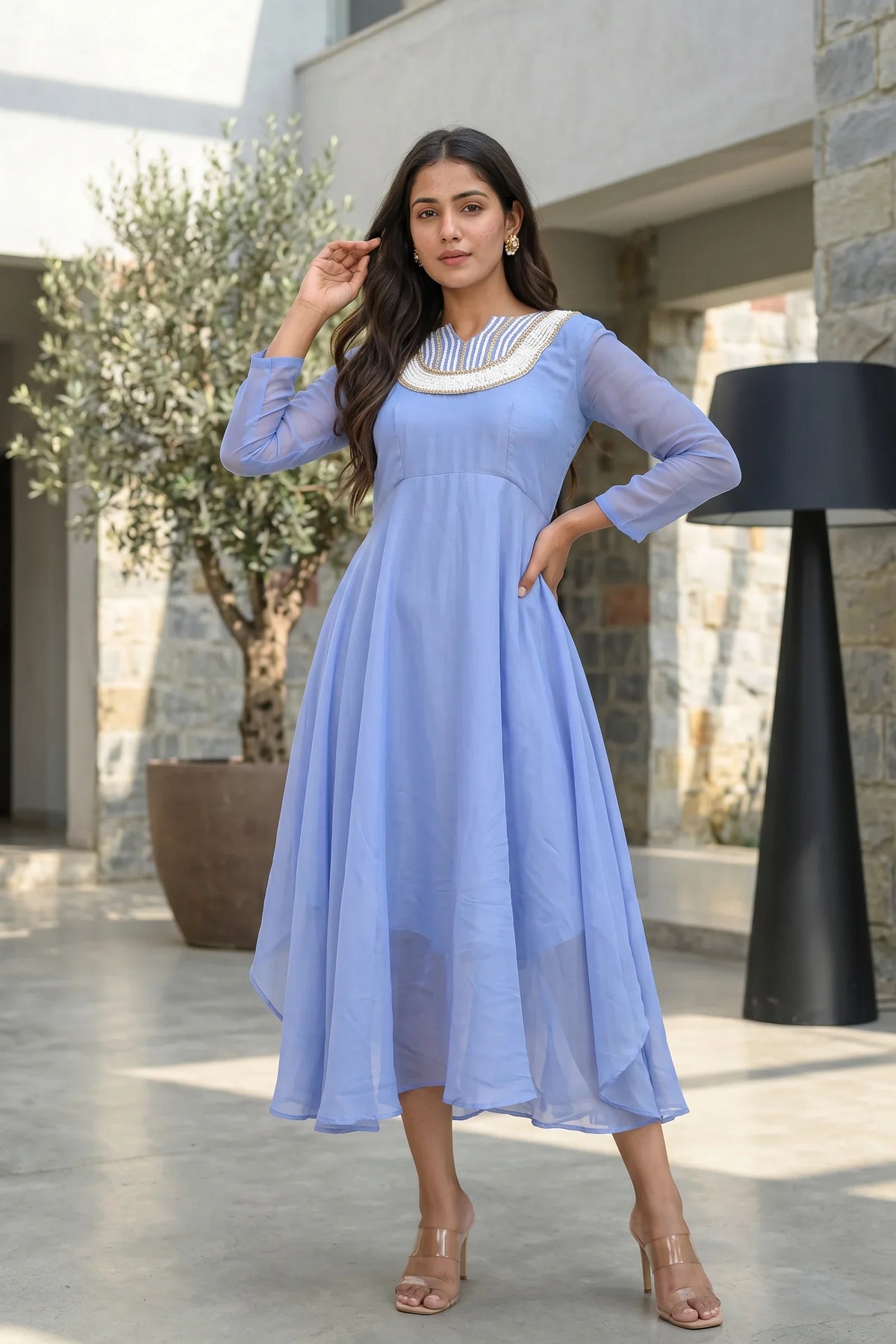
Saroj Jain pick: Baby Blue Asymmetrical Dress

Price: ₹2,336.19
Why it works: A single piece with a diagonal hem gives the drape gown silhouette with no stitching, no pleat panel and no hem to measure to a heel. It is the easiest way to test whether you even like a one piece drape before ordering one.
Best for: A cocktail evening, a mehendi lunch, or a friend's reception where you want the line of a drape without the saree formality.
Style with: Long drop earrings and strappy heels. Let the hem sit at the ankle so the asymmetry reads clearly.
Avoid if: The function needs full traditional formality. This reads modern and relaxed, not ceremonial.
Shop the Baby Blue Asymmetrical Dress
Saroj Jain pick: Bandhej Kurta and Pant Set

Visit the Saroj Jain Boutique
Discover our collections in person.
57/1, 1st Cross Rd, opposite to Iyengar's Bakery, Dollar Layout, J. P. Nagar Phase 5,Bengaluru, Karnataka 560078
+91-9314078524