
Small Space Furniture Ideas for Apartments That Actually Fit
The hardest part of furnishing an apartment is rarely choosing what you like. It is finding pieces that fit the room you actually have, leave enough floor to walk through, and still feel like furniture rather than camping gear. The good news is that a few measurements do most of the thinking for you.
Measure First, Shop Second
Sketch the room on graph paper at a quarter inch per foot and mark doors, windows, radiators, and outlets. Then pencil in the numbers that govern everything else.
- Walkways: 30 to 36 inches for a main path. In a tight studio, 24 inches between a sofa and a wall is the floor, not the goal.
- Coffee table: keep 14 to 18 inches between the sofa front and the table edge. Table height should land at 16 to 18 inches.
- Dining: allow 30 inches behind each chair for pull-out, and 24 inches of table width per person.
- Bed: 24 inches of clearance on at least two sides. Thirty feels generous.
A sofa 84 inches long can work beautifully in a 12-foot-wide living room. Depth is what usually kills a plan. Most sofas run 35 to 40 inches deep, so hunt for 32 to 34.
Seating That Does Not Swallow the Room
Apartment sofas generally land between 68 and 78 inches, and that range covers most one-bedroom living rooms. Look for a tight-back frame with exposed legs. A tight back skips the bulk of loose cushions, and visible legs let floor show through, which reads lighter than a skirted base.
Skip the recliner sofa. It needs roughly six inches of rear clearance to open, and you will lose that space permanently. A chaise sectional is a similar trap: comfortable for one person, hostile to any other arrangement of the room. If you want to lounge, choose a chair with an ottoman you can tuck under a console when guests arrive.
Two 30-inch accent chairs often work better than one 60-inch love seat, because you can split them across the room and open a path between. Swivel bases help in tight corners. Armless settees and upholstered benches, usually 48 to 60 inches, make good dining seating along a wall and pull out as extra party seating.

Tables That Change Shape
A 36-inch round table seats two comfortably and four in a squeeze. At 42 inches, four people eat without elbows in the butter. Round beats rectangular in small rooms because there are no corners to walk into and the shape reads softer against a wall.
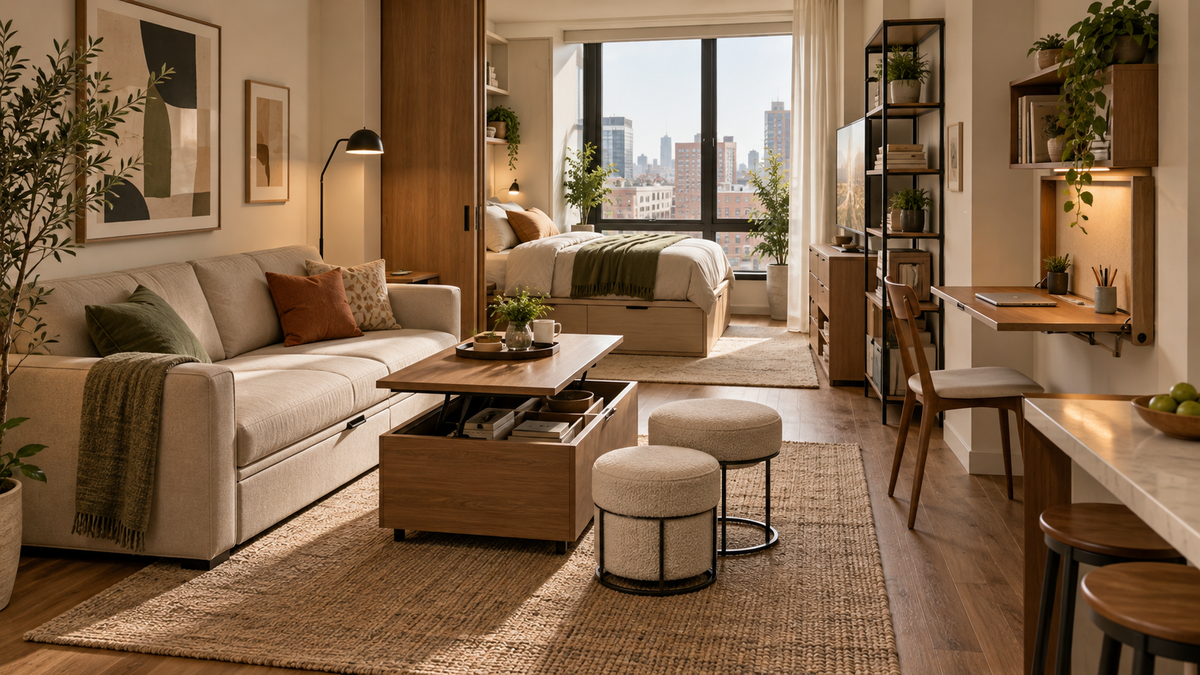
Look for drop-leaf or gateleg designs that hold at 30 to 32 inches when open and shrink to 9 or 10 inches when folded. Nesting tables handle the same problem in the living room: a 24-inch table tucked under a 20-inch one.
For desks, a wall-mounted flip-down top around 20 inches deep and 36 inches wide can serve as an office and disappear by dinner. Standard consoles at 12 to 14 inches deep give you a landing strip without eating the hallway.
Storage That Works Twice
Every piece of furniture in a small apartment should hold something. An upholstered storage ottoman doubles as a coffee table and a blanket bin. A bed with drawers or a lift-up platform reclaims the space under the box spring, which is often the largest unused volume in the apartment.
A bench at the foot of the bed at 18 to 20 inches high seats one person and swallows laundry. A coffee table with a lower shelf does the same job for books and remotes. Floating shelves at 10 to 12 inches deep hold paperbacks and small plants without stealing floor area, and stacking them in threes or fours reads intentional rather than random.
Think Vertically
Small rooms run out of floor long before they run out of height. A bookcase 72 to 84 inches tall uses one square foot and stores what two low units would. Run a shelf above a doorway for the things you use twice a year. Hang curtains close to the ceiling and let them fall to the floor, which stretches the wall.

One caution: tall, narrow pieces should be secured to the wall with the hardware that comes in the box. Renters can use removable adhesive straps rated for the weight.
Questions I Get Asked Most
Is a sectional ever right in a small apartment? Yes, in one specific case: an L-shaped room where the long wall is at least 10 feet and the short leg lands against a window-free corner. Otherwise a straight sofa plus a chair gives you more layouts.
What is worth spending more on? The sofa and the mattress. Both take the most daily wear and are the hardest to replace.
Do mirrors really help? They help by reflecting light and view, not by creating floor. A large mirror opposite a window genuinely brightens a dark room.
Buy fewer things and buy them at the right scale. A small apartment furnished with six pieces that fit perfectly always looks better than one filled with ten that almost do.
Saroj Jain is a designer boutique in Bengaluru — visit us in person or get directions.