
Chikankari Fabric And Styling
Updated: August 2026 | Written by: Saroj Jain | Reviewed by: Saroj Jain Boutique Team
Chikankari fabric and styling becomes easy when you stop treating every embroidered garment the same. Cotton works for long office days. Mulmul handles Bengaluru heat. Georgette, chiffon, silk, and organza change the mood through drape, shine, and structure. The real buying question is simple: does the fabric suit your day, and does the embroidery deserve the price? At our JP Nagar 5th Phase boutique, we check how a piece moves while sitting, walking, and layering. We also inspect the reverse side, not just the front. This guide gives you a clear way to buy, style, and wear Lucknowi Chikankari with confidence.
Quick answer: Choose cotton or mulmul for everyday Chikankari, georgette or chiffon for fluid festive looks, and silk or organza for structure. To check handwork, turn the garment inside out. Natural stitch variation, visible thread movement, small knots, and shadow work point toward hand embroidery. Perfectly repeated motifs and a highly uniform reverse often indicate machine work.[1][2][3]
- Choose the right Chikankari fabric
- Style it for daily wear
- Style it for festive occasions
- Check hand-embroidered Chikankari
- Match fabric to silhouette
- Saroj Jain product picks
- Compare fabrics and outfits
- Body type styling matrix
- What to avoid
- Frequently asked questions
- Visit our JP Nagar boutique
Choose the Right Chikankari Fabric
Cotton: Best for work, errands, travel, and warm weather. It holds a clean kurta shape and feels practical through long days.
Mulmul: Softer and lighter than regular cotton. It creates an easy, airy look, but may need a lining or careful layering because of its fine weave.
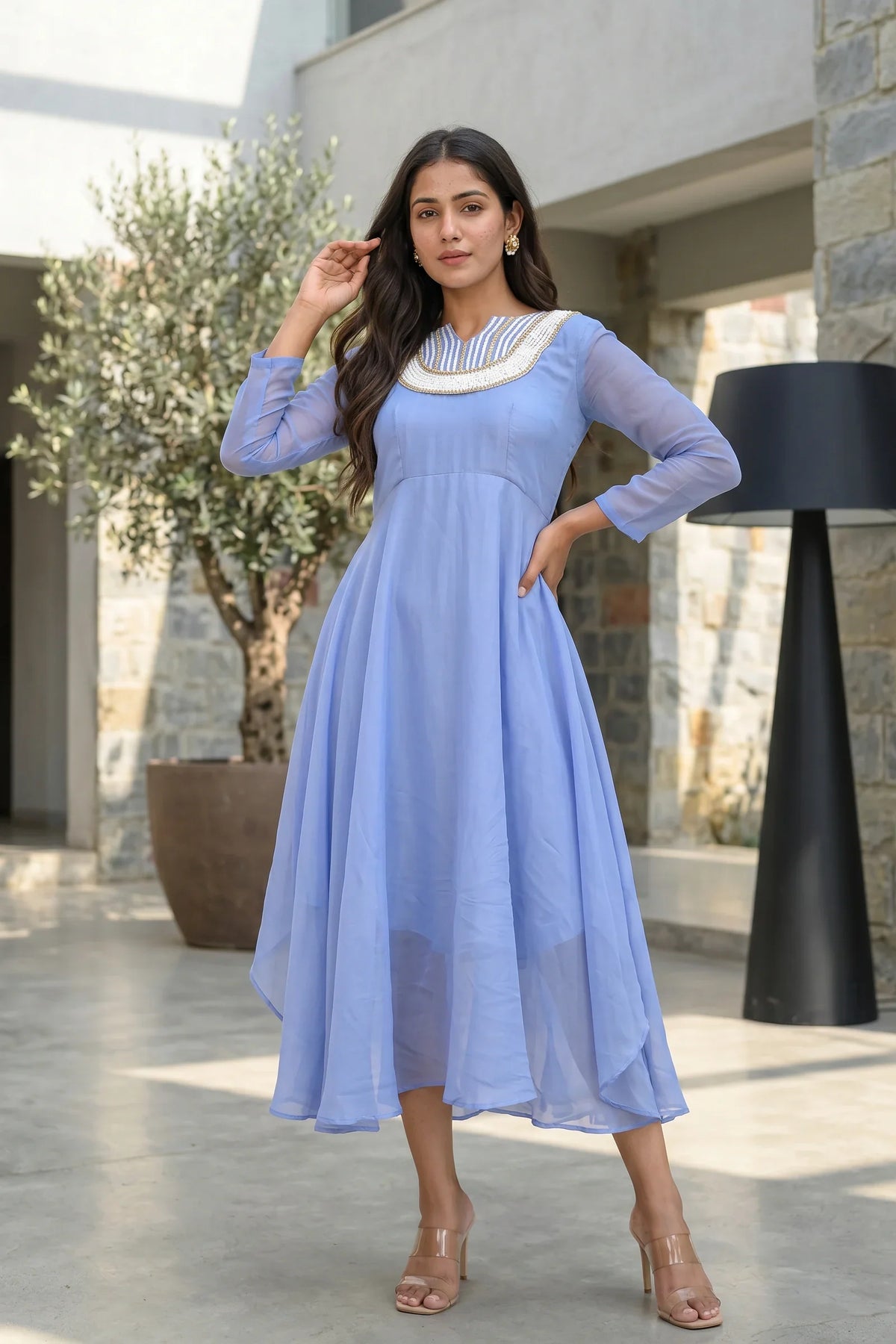
Georgette: Fluid, slightly textured, and suitable for anarkalis, sarees, and dressier kurtas. It falls close to the body without looking stiff.
Chiffon: Light and floaty. It works well for sarees and dupattas, but needs sensible lining and secure finishing.
Silk: Gives Chikankari more body and a richer finish. Use it for festive kurtas, jackets, sarees, and occasion separates.
Organza: Crisp and structured. It suits sleeves, jackets, overlays, and statement dupattas more than relaxed daily kurtas.
Chikankari Kurti Styling for Daily Wear
For office dressing, start with a cotton or mulmul Chikankari kurta. Add straight trousers, small earrings, and flat sandals. Keep the colour palette calm so the embroidery stays visible.
For Bengaluru weather, breathable fabric matters more than heavy decoration. A light kurta with a cotton lining is easier to wear from morning to evening than a dense synthetic fabric.
At our boutique, we watch how a kurta behaves when clients sit cross-legged for hours. If the fabric pulls at the hip or the embroidery catches on the chair, the piece is not practical for daily wear.
Chikankari Styling for Festive Occasions
Use a flowy fabric for movement and a structured fabric for definition. Georgette and chiffon suit anarkalis and sarees. Silk and organza suit jackets, overlays, and sharper festive separates.
For a wedding function, let one detail lead. Choose either statement earrings, a rich dupatta, or embellished footwear. Adding all three can hide the quiet beauty of the embroidery.
Daytime lighting in Bengaluru can make pale embroidery look softer than expected. Try the garment near a window before choosing jewellery or makeup. Warm gold may work better indoors, while silver or pearls can look cleaner in daylight.
How to Check Hand-Embroidered Chikankari
Start with the reverse side. Hand embroidery generally shows the artisan’s thread path, small knots, slight stitch variation, and different tension across motifs. Machine embroidery usually looks more uniform and repetitive.[1][2][5]
Look at more than one flower. If every petal, leaf, and spacing mark is perfectly identical, ask whether the piece is machine-made. Handwork can be neat and skilled without being mechanically identical.[1][3]
Feel the surface. Handwork often has a soft, gently raised texture. Dense machine embroidery can feel flatter, harder, or unusually heavy for the fabric.[1][9]
Check for shadow work. Bakhia creates a soft shadow effect through the fabric and is a useful sign to inspect closely, especially on fine or translucent grounds.[4][8]
Ask the seller direct questions. Is it hand-embroidered? Which fabric is used? Is the work done before stitching the garment? A transparent answer matters as much as the motif.
Match the Silhouette to the Textile
Cotton and mulmul: Choose straight kurtas, relaxed co-ords, shirt dresses, and light layers.
Georgette and chiffon: Choose anarkalis, sarees, soft skirts, and fluid dupattas.
Silk: Choose structured kurtas, short jackets, panelled dresses, and festive sarees.
Organza: Choose overlays, cropped jackets, sleeves, peplum layers, and crisp dupattas.
The rule is practical. Do not force a stiff fabric into a relaxed silhouette, and do not expect a very fluid fabric to hold a sharp jacket without lining.
Saroj Jain Picks for Chikankari Dressing
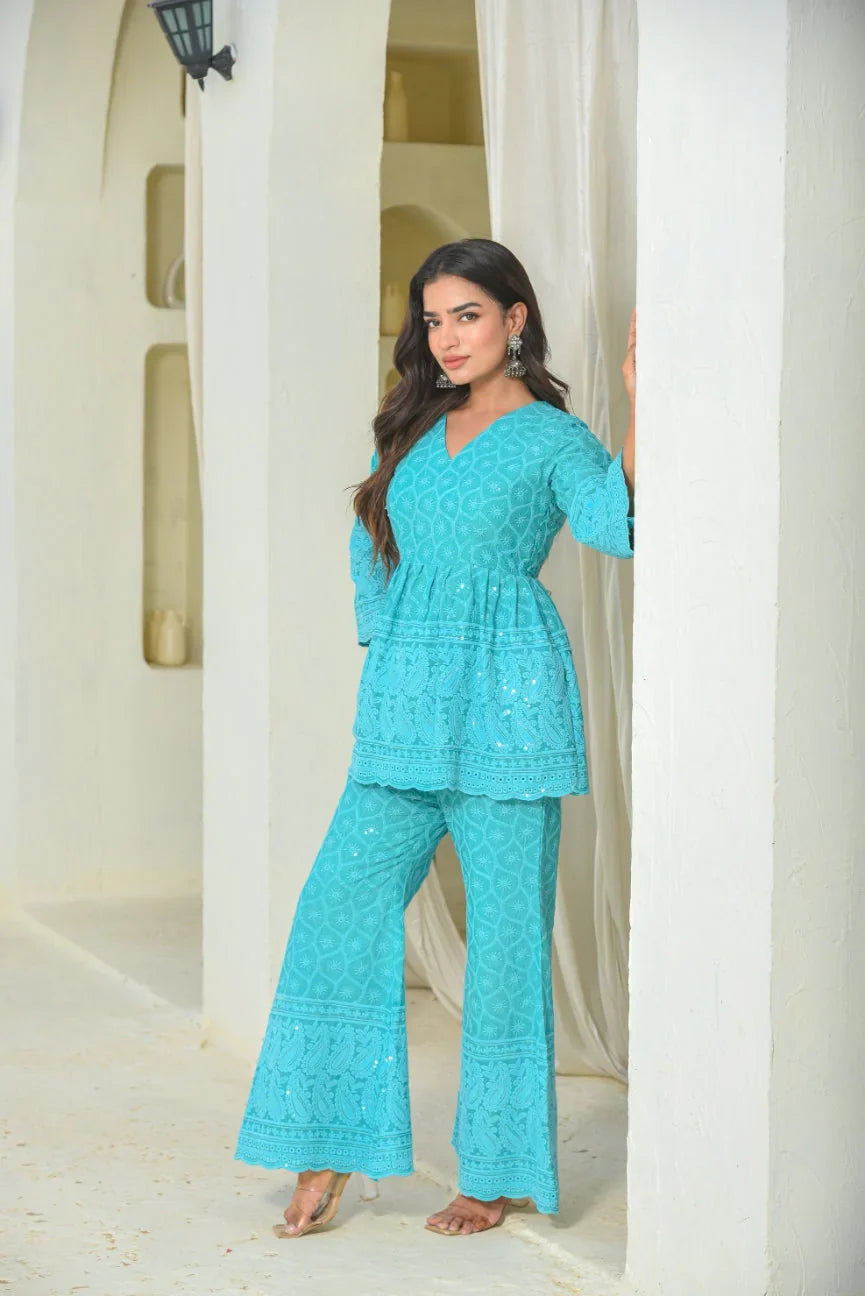
Saroj Jain pick: Chikankari Co-Ord Set

Price: ₹2,771.37
Why it works: Matching separates give Chikankari a clean contemporary finish without losing its traditional surface detail.
Best for: Lunches, work events, travel, and polished daytime dressing.
Style with: Pearl studs, a compact shoulder bag, and flat or low block-heel sandals.
Avoid if: You prefer a very loose silhouette or need a high-contrast festive outfit.
Shop the Chikankari Co-Ord Set
Saroj Jain pick: Mint Sea Green Lucknowi Chikankari Anarkali Gown

Price: ₹4,399
Why it works: The anarkali silhouette lets fluid fabric move while keeping the embroidery as the visual focus.
Best for: Day weddings, festive lunches, family celebrations, and engagement events.
Style with: Silver jhumkas, soft metallic sandals, and a small potli or clutch.
Avoid if: You need a short, easy-to-pack outfit for frequent travel.
Shop the Mint Sea Green Lucknowi Chikankari Anarkali Gown
Saroj Jain pick: Ombre Lavender Pink & Crimson Red Lucknowi Chikankari Anarkali Gown

Price: ₹4,499
Why it works: The ombre colour does the styling work, while the Lucknowi embroidery keeps the finish rooted and graceful.
Best for: Evening celebrations, cocktail-style festive events, and wedding receptions.
Style with: Ruby-toned earrings, minimal bangles, and pointed heels.
Avoid if: You want a soft monochrome outfit with very little colour contrast.
Shop the Ombre Lavender Pink & Crimson Red Lucknowi Chikankari Anarkali Gown
Saroj Jain pick: Ombre Pink & Lime Green Lucknowi Chikankari Anarkali Gown
Price: ₹4,799
Why it works: The bright ombre palette gives the Anarkali a festive presence, while the embroidery adds texture instead of extra shine.
Best for: Haldi events, daytime weddings, festive dinners, and sangeet celebrations.
Style with: Gold-toned earrings, nude or gold sandals, and a restrained bracelet.
Avoid if: You are looking for a muted neutral outfit for formal office settings.
Shop the Ombre Pink & Lime Green Lucknowi Chikankari Anarkali Gown
Chikankari Fabric and Outfit Comparison
| Outfit | Fabric direction | Festive scale | Price |
|---|---|---|---|
| Chikankari Co-Ord Set | Lightweight, coordinated separates | Low to medium | ₹2,771.37 |
| Mint Sea Green Lucknowi Chikankari Anarkali Gown | Flowing gown silhouette | Medium to high | ₹4,399 |
| Ombre Lavender Pink & Crimson Red Lucknowi Chikankari Anarkali Gown | Flowing ombre occasion layer | High | ₹4,499 |
| Ombre Pink & Lime Green Lucknowi Chikankari Anarkali Gown | Bright festive gown | High | ₹4,799 |
Body Type and Silhouette Matrix
| Body profile | Most useful silhouette | Styling adjustment |
|---|---|---|
| Petite | Short kurta, straight pants, or a lightly flared Anarkali | Keep the hem clean and avoid too many competing layers. |
| Tall | Long Anarkali, saree, or jacket over separates | Use a longer dupatta or strong border to balance vertical length. |
| Curvy | Panelled Anarkali, straight kurta, or open long jacket | Choose breathable lining and let the fabric skim instead of cling. |
| Lean | Layered co-ord, flared Anarkali, or textured organza jacket | Add visual width through sleeves, panels, or a softly draped dupatta. |
Modern Chikankari Styling Without Losing Its Character
Pair a Chikankari kurta with tailored trousers instead of matching bottoms. Add a structured handbag and simple footwear. The contrast makes the embroidery feel current without turning it into costume dressing.
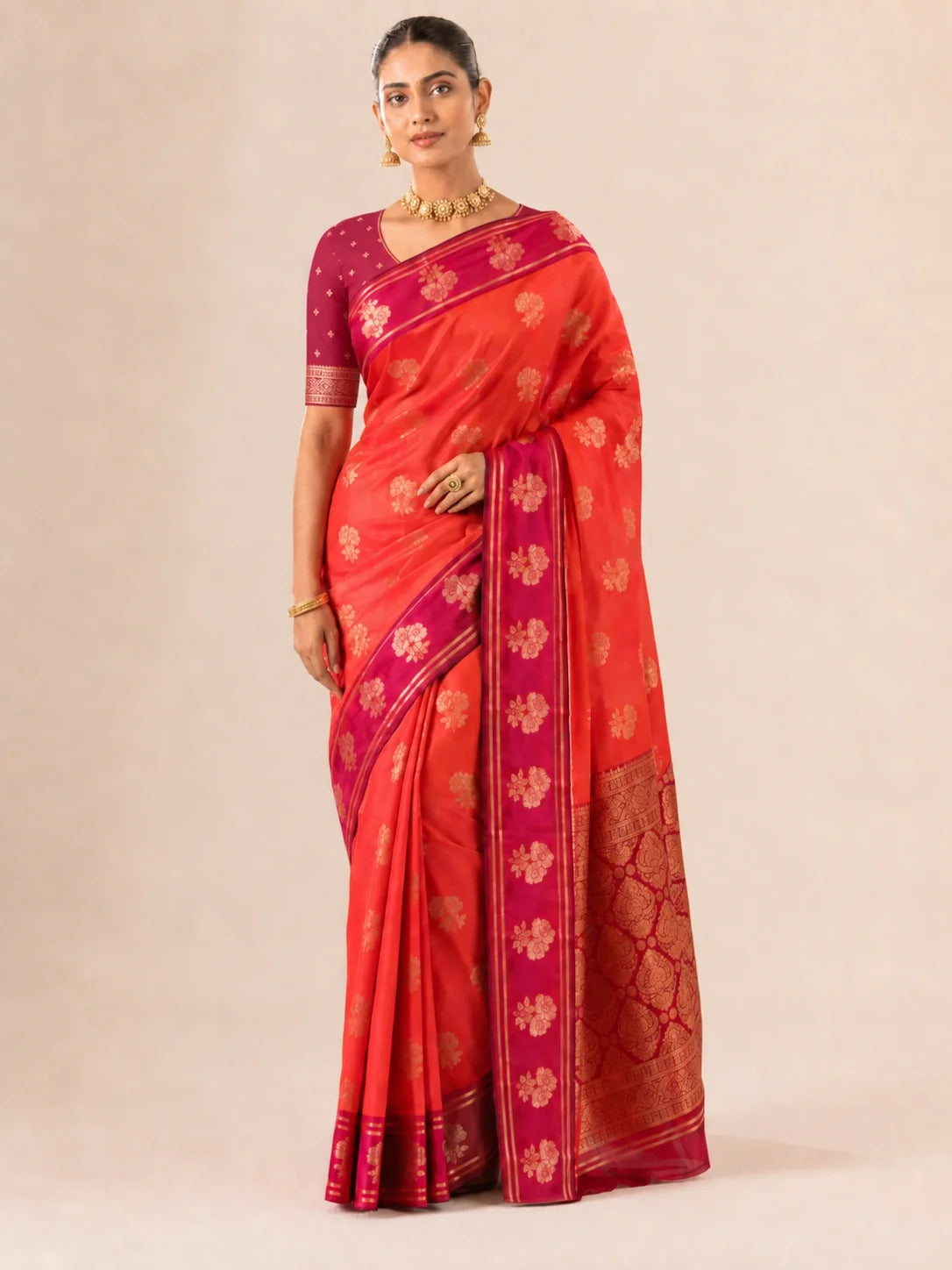
For Chikankari saree styling, use a clean blouse and let the pallu carry the embroidery. Avoid a heavily embroidered blouse, necklace, belt, and embellished sandals together.
A short silk or organza jacket over a simple Chikankari base creates a sharper fusion outfit. Keep the jacket lined so it holds shape and does not snag the softer fabric underneath.
Care That Protects the Embroidery
Wash lightly and avoid aggressive scrubbing over the motifs. Harsh chemicals can weaken thread and affect delicate fabrics.
Dry in shade rather than harsh direct sun. Store the garment folded with the embroidery facing inward or supported by soft tissue to reduce snagging.
Before ironing, turn the garment inside out and use low heat. For organza, silk, and fine georgette, professional care is safer than repeated high-temperature pressing.
What to Avoid
- Do not judge authenticity from the front alone. Inspect the reverse side.
- Do not buy a transparent fabric without checking lining, especially for daily wear.
- Do not pair heavy jewellery with dense embroidery unless the event truly needs it.
- Do not choose a stiff fabric for a silhouette that depends on soft movement.
- Do not ignore sitting comfort. A beautiful kurta that pulls at the hip will stay in the wardrobe.
- Do not call every white embroidered garment hand Chikankari without asking about the process.
- Do not use harsh detergent or high heat on delicate embroidery.
Frequently Asked Questions
How can I tell whether Chikankari is genuinely hand-embroidered or machine-made?
Turn the garment inside out and inspect stitch movement, small knots, thread ends, and variation in tension. Handwork usually has natural differences, while machine embroidery tends to repeat with high uniformity.[1][2][5]
Which fabric is best for a Chikankari cotton kurta?
Cotton is the most practical option for regular wear. Mulmul is lighter and softer, making it useful for warm weather, relaxed dressing, and easy layering.
Is Lucknowi Chikankari fabric suitable for Bengaluru weather?
Yes. Cotton and mulmul are especially comfortable in warm daytime conditions. Choose breathable lining and avoid heavy synthetic layers when you expect long hours outdoors.
Which Chikankari fabric is best for weddings?
Georgette and chiffon suit fluid gowns and sarees. Silk and organza suit structured jackets, festive separates, and sharper silhouettes.
How do I style Chikankari for an office?
Choose a cotton kurta, straight trousers, modest earrings, and flat sandals. Keep the colour story quiet and the fit comfortable enough for sitting and commuting.
Can I wear Chikankari with jeans?
Yes. A shorter kurta or embroidered top works with straight or wide-leg jeans. Keep the footwear clean and the accessories limited.
How should I style a Chikankari saree?
Use a simple blouse, controlled jewellery, and one strong accessory. Let the embroidered saree or pallu remain the main detail.
How should I care for hand-embroidered Chikankari?
Use gentle washing, shade drying, low heat, and careful storage. Do not pull loose threads or scrub directly over the embroidered areas.
Ready to Find Your Fit? Visit Our JP Nagar Boutique
Visit SAROJ JAIN at 57/1, 1st Cross Rd, opposite to Iyengar's Bakery, 5th Phase, Dollar Layout, JP Nagar Phase 5, Bengaluru, Karnataka 560078.
We can help you compare fabric weight, check the fall, test sitting comfort, and choose jewellery that works in real Bengaluru daylight.
Choose the fabric first, check the embroidery second, and let the silhouette finish your chikankari fabric and styling.
Visit the Saroj Jain Boutique
Discover our collections in person.
57/1, 1st Cross Rd, opposite to Iyengar's Bakery, Dollar Layout, J. P. Nagar Phase 5,Bengaluru, Karnataka 560078
+91-9314078524