

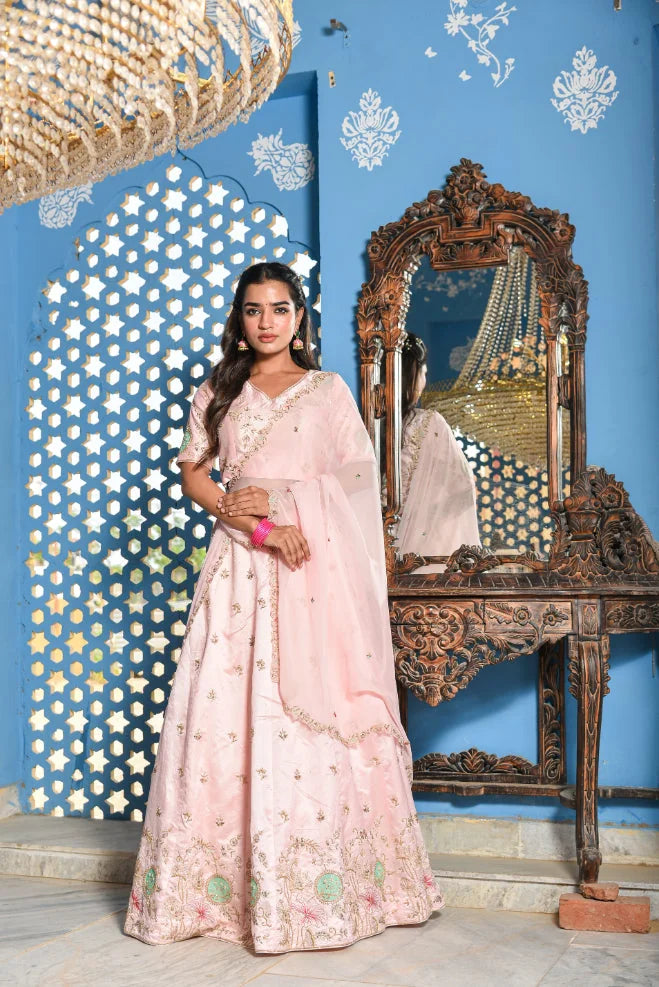
How to Coordinate Family Outfits for Indian Weddings
Ever showed up at a wedding where seven family members are wearing seven different colour schemes and nothing makes sense in photos?
We see this at our JP Nagar boutique all the time. A family walks in. Everyone has a different idea. The mother wants pastels. The daughter wants jewel tones. The son just wants to blend into the wallpaper. By the time they leave, someone always compromises. And it shows in every wedding album for the next twenty years.
Coordinating family outfits is not about dressing identically. It is about looking like you belong together without anyone losing their personality. Here is how we guide families through it.

Key Takeaways
- Pick 2-3 base colours and let everyone choose their shade within that palette
- Match fabric weights across family members so photographs look balanced
- Coordinated means complementary, not identical . avoid matchy-matchy outfits
- Accessories (dupattas, jewellery, footwear) do the heavy lifting for cohesion
- Start with the person who cares most and build outward from there
Start With a Colour Palette, Not Matching Outfits
The most common mistake families make is trying to wear the exact same colour. It sounds good in theory. In practice, five people in identical mustard yellow look like a wedding catering team.
Instead, pick two or three base colours. For a summer wedding, try blush pink, ivory, and soft gold. One person wears the blush. Another wears ivory with blush embroidery. A third wears gold with ivory accents. Everyone reads as coordinated. No one reads as cookie-cutter.
At our boutique, we lay fabric swatches side by side on the consultation table. We check how they look under both natural light and warm light because venues change everything. A colour that works in our studio at 2 PM can look completely different under banquet hall chandeliers at 9 PM.
Fabric Weight Matters More Than You Think
Here is something nobody tells you about family photos. The camera picks up fabric weight before it picks up colour. If your mother is in heavy brocade and your sister is in lightweight georgette, the contrast reads as disjointed. Even if the colours match perfectly.
We recommend keeping fabric weights consistent across the core family group. For daytime functions like haldi or mehendi, go with lightweight cottons, chanderi, or organza across everyone. For evening receptions, silk blends and heavier embroideries work together.
Who Sets the Tone?
Simple rule from thousands of family fittings. Start with the person who has the strongest opinion. Usually it is the mother or the bride. Get their outfit finalized first. Then build everyone else around that anchor piece.
If the mother of the bride is wearing a rani pink silk saree, you now have your colour anchor. Everyone else picks shades that complement rani pink. Maybe sage green for the sister. Maybe ivory with pink border for the aunt. The anchor piece solves a hundred small decisions before they become arguments.
Matching vs Coordinating: A Quick Comparison
| Matching (Don't Do This) | Coordinating (Do This) |
|---|---|
| All five people in identical navy blue | One in navy, one in powder blue, one in ivory with navy embroidery |
| Same fabric, same silhouette, same everything | Same colour family, different fabrics and cuts suited to each person |
| Identical dupatta drapes on every woman | Shared border or motif on dupattas, unique draping styles |
| Everyone looks like a uniform | Everyone looks like they belong to the same family |
Accessories Do the Heavy Lifting
If you are on a budget or short on time, do not redo everyone's outfit. Use accessories to tie the family together. A shared dupatta border motif across all the women. Similar jewellery tones (all gold or all silver). Matching footwear formality level.
We have seen families coordinate beautifully with nothing more than a shared gota border on every dupatta. Each woman wore her own colour. Each outfit was unique. But the moment they stood together, the border tied them into one frame.

What to Avoid
- Five people in the exact same shade (looks like a uniform, not a family)
- Mixing bridal-weight outfits with casual daywear (the contrast screams "we did not plan this")
- One person in blinding neon when everyone else is in soft pastels (they will dominate every photo)
- Forgetting to check colours under evening lighting if the function is at night
- Coordinating only the women and leaving the men in whatever they grabbed from the wardrobe
Our Picks for Family Coordination
For the mother or elder sister: The Beige Zari Silk Anarkali Set works as an anchor piece. The neutral beige with zari detailing complements almost every colour palette. Pair it with gold jewellery and let the rest of the family build around the zari tone.
For the younger sister or cousin: The Blue Mastani Anarkali Set brings a rich jewel tone that stands out without clashing. Works beautifully alongside beige, ivory, gold, and soft pink anchors.
For men: The Olive Green Bandhej Kurta Set offers a grounded, earthy tone that anchors brighter women's outfits. Olive green is the unsung hero of family coordination. It complements pink, blue, gold, ivory, and coral without competing.
Explore our full collection at sarojjain.com/collections/all or WhatsApp us at +91 9314078524 for personalized family outfit planning.
FAQs
Should all family members wear the same colour to a wedding?
No. The same colour on everyone photographs poorly and looks like a uniform. Pick a palette of 2-3 related colours and distribute shades across family members. The result is cohesive without being identical.
How do I coordinate outfits if family members have very different styles?
Start with the colour palette as the fixed element. Let each person choose their own silhouette within that palette. Your mother may prefer a saree while your sister wants a lehenga. As long as the colours talk to each other, the photos will work.
What fabric works best for coordinated family photos?
Fabrics with a slight texture or sheen photograph best. Chanderi, raw silk, organza, and zari-work fabrics catch light without overwhelming the frame. Avoid shiny synthetics that create hot spots under flash photography.
Can I coordinate family outfits on a budget?
Yes. Use accessories instead of new outfits. A shared dupatta border, matching jewellery tone, or similar footwear elevates existing outfits into a coordinated look. You do not need to buy everything new.
What if the men refuse to participate in outfit coordination?
We hear this constantly at the boutique. The trick is to coordinate the men subtly. A kurta in a complementary colour to the women's palette. Matching pocket squares. Same footwear formality. They will not feel dressed up. But the photos will look intentional.
Still figuring out your family's wedding look? Visit our boutique in JP Nagar, Bangalore or browse sarojjain.com. We do this every day. Let us make it easy for you.