
Designer Blouse Stitching
Updated: August 2026 | Written by: Saroj Jain Styling Team | Reviewed by: Saroj Jain Boutique Team
Designer blouse stitching works when the fit, fabric and saree are planned together. A beautiful neck design cannot rescue a blouse that pulls at the bust, cuts into the armhole or gaps at the back. At our JP Nagar 5th Phase boutique, we check how the blouse behaves when you sit, raise your arms and drape the saree properly. Bangalore weather also matters. A heavy inner layer that feels fine for ten minutes can feel uncomfortable during a long function. The right blouse needs structure where it is needed, ease where you move and finishing that stays comfortable for hours.
Quick answer: Start with the saree, then decide the blouse silhouette, fabric support, neckline, sleeves and back closure.
For reliable blouse cutting and stitching, take measurements over the intended innerwear, test the fabric, use the right lining and complete a trial before final finishing.
Fit should be checked while sitting, moving both arms and wearing the actual saree drape.
Contents
- Fit comes before decoration
- Measurements that affect comfort
- Fabric behavior changes the fit
- Lining and interlining choices
- Choosing the front neck
- Planning the blouse back neck design
- Sleeve and armhole balance
- Bridal blouse stitching plan
- Saroj Jain styling picks
- Silhouette matrix
- What to avoid
- Frequently asked questions
- Visit our JP Nagar boutique
Fit Comes Before Decoration
Our first rule is simple. A plain blouse with a clean fit looks stronger than an embellished blouse with pulling, gaping or loose armholes.
During a boutique fitting, we ask you to sit cross-legged, lift both arms and turn your shoulders. This reveals pressure points that standing in front of a mirror will not show.
Leave enough ease for breathing and movement. Do not add extra room everywhere. Excess ease can create side gaps and weaken the shape of the blouse.
Measurements That Affect Comfort
A saree blouse needs more than bust and waist measurements. Shoulder width, armhole depth, upper arm, sleeve length, front neck depth, back neck depth and blouse length all affect the final result.
- Bust: Measure around the fullest point without pulling the tape tight.
- Shoulder: Keep the tape across the natural shoulder line.
- Armhole: Check circumference and depth. Too tight restricts movement. Too loose creates side gaps.
- Blouse length: Decide where the hem should sit with the saree drape.
- Neck depth: Measure from the base of the neck to the finished neckline.
- Sleeve: Confirm length and upper-arm comfort in the intended posture.
Measurements should be taken in the innerwear you plan to wear with the saree. A change in bra style or padding can change the blouse fit.
Fabric Behavior Changes the Fit
Fabric does not simply cover the body. It changes the structure, movement and appearance of the blouse.
| Fabric | What it does | Good use | Watch for |
|---|---|---|---|
| Raw silk | Holds shape well | Festive and bridal blouses | Can feel firm without a soft lining |
| Velvet | Adds depth and warmth | Evening and winter functions | Can feel heavy in warm weather |
| Organza | Looks crisp and light | Statement sleeves and overlays | Needs careful finishing and support |
| Net or lace | Creates a sheer effect | Party and bridal details | Needs suitable lining and stable seams |
| Soft silk | Drapes close to the body | Elegant saree pairings | May need light support for sharp necklines |
For embroidery-heavy blouse stitching, we usually prefer a stable outer fabric with support underneath. Very soft fabric can lose shape around the neckline and armhole once embroidery or beads add weight.
Lining and Interlining Choices
Lining touches the body. Interlining sits between the outer fabric and lining to add support. They do different jobs.
- Cotton lining: Useful when breathability matters, especially in Bangalore weather.
- Shantoon lining: Works well under sheer or dressy outer fabrics.
- Light interlining: Helps a soft fabric hold the neckline and shoulder line.
- Firm support: Useful for embroidery, heavy borders and structured bridal designs.
Too much support can make the blouse stiff and hot. Too little support can lead to a collapsing neckline, stretched armhole or uneven embroidery placement.
We check the support layer at the shoulder, neck and armhole first. These areas carry much of the blouse’s visual and physical strain.
Choosing the Front Neck
The neckline should work with the saree border, jewellery and body proportions. Do not select a design only because it looks good in a catalogue image.
- V neck: Draws the eye vertically and works well when you want a longer upper-body line.
- Sweetheart neck: Softens the bust line and suits feminine festive styling.
- Boat neck: Adds width across the shoulder line and pairs well with statement earrings.
- Square neck: Gives a clear frame and works well with structured fabrics.
- Round neck: Practical, balanced and easy to style with layered jewellery.
- High neck: Strong for minimal sarees and embroidery-led designs, but needs comfortable depth.
Heavy saree borders usually need a calmer neckline. If both the saree border and blouse neck are highly detailed, the outfit can look crowded.
Planning the Blouse Back Neck Design
The back neck is visible through the saree drape, especially when the pallu is pinned or worn over one shoulder. It needs both design and support.
A deep back can be finished with hooks, a dori, covered buttons or a structured panel. The closure should hold the blouse securely without digging into the skin.
For bridal blouse stitching, place embroidery after confirming the back depth and seam position. Design lines can shift when the blouse is shaped for the body.
We also check whether the back design stays in place when you sit. A deep back that looks good while standing may pull down or open when you move.
Sleeve and Armhole Balance
Sleeves change the whole fit. A tight sleeve can pull the blouse upward. A low armhole can restrict movement. A wide armhole can expose the innerwear and create wrinkles.
- Short sleeves: Keep the hem smooth and avoid cutting across the fullest part of the upper arm if you prefer a longer line.
- Elbow sleeves: Check sitting and arm movement before final finishing.
- Puff sleeves: Need controlled volume so the shoulder does not look wider than intended.
- Sheer sleeves: Need clean inner finishing and a lining plan.
- Sleeveless styles: Need a carefully shaped armhole to prevent side exposure.
Do not solve a tight armhole by simply widening it. The shoulder, bust and sleeve cap may also need correction.
Bridal Blouse Stitching Plan
Bridal blouse stitching needs a clear sequence. Start with the saree, jewellery, wedding function, fabric and sitting duration.
- Confirm the saree colour, border and drape.
- Choose the blouse fabric and support layers.
- Approve the front neck, back neck and sleeve shape.
- Place embroidery around seams, bust shaping and closures.
- Complete a trial before final hooks, tassels and embellishments.
- Test the blouse with the actual saree and jewellery.
For long ceremonies, comfort is part of the design. A blouse that looks perfect for a photograph but hurts after an hour is not a successful bridal blouse.
Saroj Jain Styling Picks
Saroj Jain pick: Scarlet Radiance Handwoven Tissue Fusion Saree (With Rich Fuchsia Woven Blouse)

Price: ₹946.05
Why it works: The rich fuchsia woven blouse already creates contrast, so the saree can carry a clean, structured blouse line.
Best for: Festive dinners, receptions and daytime celebrations.
Style with: Gold jhumkas, a slim bangle stack and pointed sandals.
Avoid if: You want a very soft, muted outfit with minimal colour contrast.
Shop the Scarlet Radiance Handwoven Tissue Fusion Saree (With Rich Fuchsia Woven Blouse)
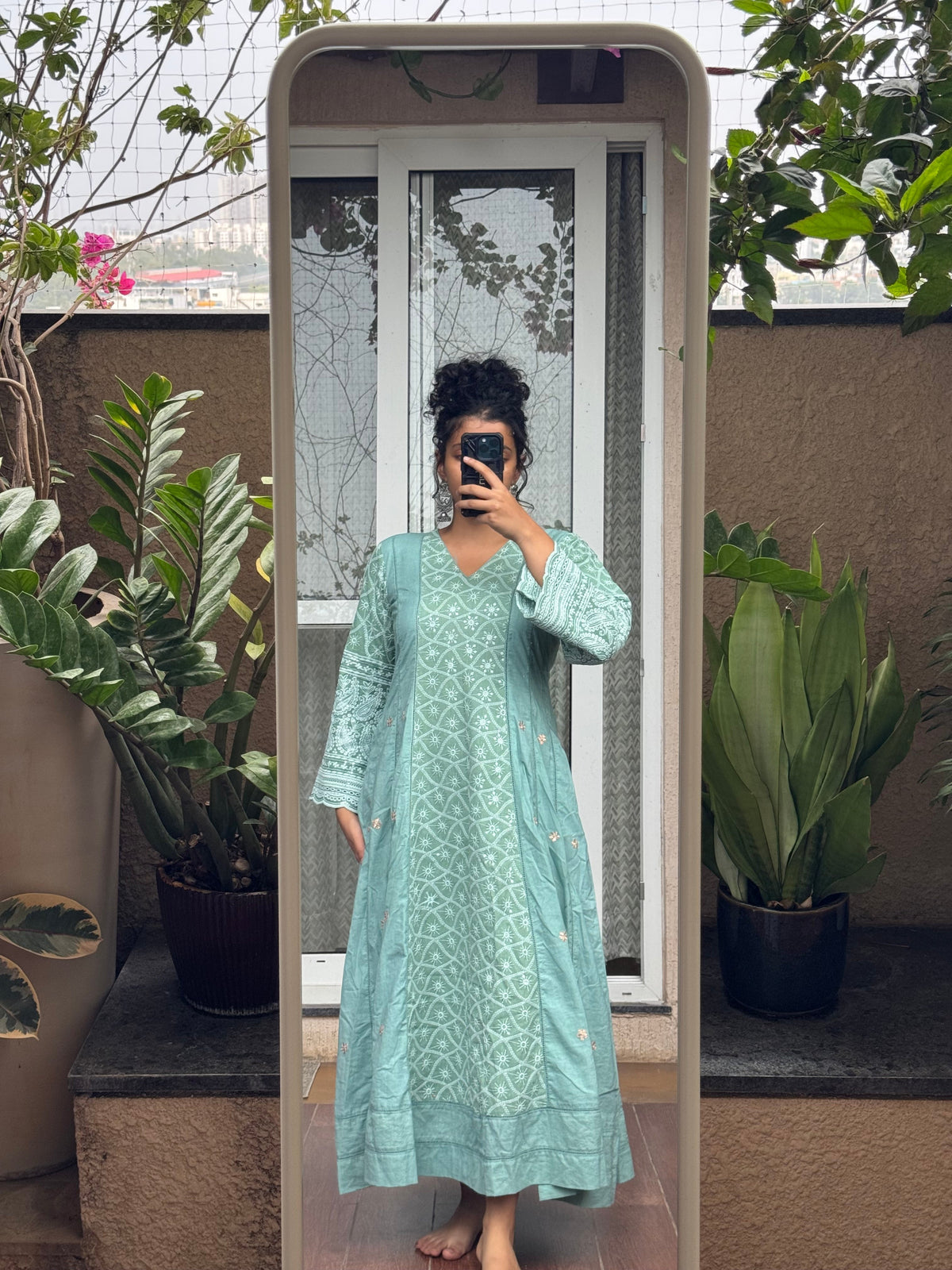
Saroj Jain pick: Mint Sea Green Lucknowi Chikankari Anarkali Gown

Price: ₹4,399
Why it works: The soft colour and chikankari detail suit a controlled neckline and light sleeve treatment.
Best for: Day functions, festive lunches and family celebrations.
Style with: Pearl drops, nude heels or embellished flats.
Avoid if: You need heavy contrast or a dramatic evening look.
Shop the Mint Sea Green Lucknowi Chikankari Anarkali Gown
Saroj Jain pick: Ombre Pink & Lime Green Lucknowi Chikankari Anarkali Gown

Price: ₹4,799
Why it works: The colour transition gives the outfit visual interest, so the neckline can stay clean and easy to wear.
Best for: Haldi events, festive parties and spring daytime occasions.
Style with: Fresh-toned earrings, a small potli and comfortable block heels.
Avoid if: You prefer a single-colour outfit with low visual contrast.
Shop the Ombre Pink & Lime Green Lucknowi Chikankari Anarkali Gown
Saroj Jain pick: Ombre Sky & Indigo Blue Lucknowi Chikankari Anarkali Gown

Price: ₹4,399
Why it works: The blue ombre effect supports clean tailoring and gives room for silver or oxidised accessories.
Best for: Evening gatherings, festive dinners and formal celebrations.
Style with: Silver earrings, a compact clutch and low block heels.
Avoid if: Your event requires warm gold styling from head to toe.
Shop the Ombre Sky & Indigo Blue Lucknowi Chikankari Anarkali Gown
Outfit Comparison
| Outfit | Fabric or surface | Festive scale | Price |
|---|---|---|---|
| Mint Sea Green Lucknowi Chikankari Anarkali Gown | Lucknowi chikankari | Soft festive | ₹4,399 |
| Ombre Pink & Lime Green Lucknowi Chikankari Anarkali Gown | Ombre chikankari | Bright festive | ₹4,799 |
| Ombre Sky & Indigo Blue Lucknowi Chikankari Anarkali Gown | Ombre chikankari | Evening festive | ₹4,399 |
| Scarlet Radiance Handwoven Tissue Fusion Saree (With Rich Fuchsia Woven Blouse) | Handwoven tissue fusion | High contrast festive | ₹946.05 |
Body Type and Silhouette Matrix
| Silhouette | Neckline direction | Sleeve direction | Fit note |
|---|---|---|---|
| Petite | Moderate V or smaller square neck | Short or neat elbow sleeve | Keep motifs and borders proportional |
| Tall | Boat, square or wider round neck | Elbow or statement sleeve | Use the blouse length to balance the saree |
| Curvy | V or sweetheart neck | Comfortable sleeve with clean armhole | Use shaping, lining and enough bust ease |
| Lean | Boat, round or higher neckline | Puff, layered or wider sleeve | Add structure without making the blouse stiff |
These are starting points, not fixed rules. The saree border, fabric weight, jewellery and personal comfort can change the best choice.
What to Avoid
- Do not copy a neckline without checking the fabric’s ability to hold it.
- Do not take measurements over loose clothing.
- Do not skip the trial for bridal or embroidery-heavy designs.
- Do not make the armhole tight to create a sharper fit.
- Do not use thick interlining in every fabric.
- Do not place heavy embroidery directly over a seam without checking movement.
- Do not finalise the back depth before confirming the saree drape.
- Do not ignore Bangalore’s warm, changeable weather when choosing lining.
Frequently Asked Questions
Will the blouse fit correctly without multiple alterations?
Accurate measurements and one proper trial can reduce alterations. We check the blouse while standing, sitting, raising the arms and wearing the intended saree drape.
How much does designer blouse stitching cost?
Cost depends on the design, fabric, lining, interlining, embroidery, sleeve construction, closures and trial requirements. Ask for the current quote before confirming the order.
Which fabric is best for embroidery-heavy or party-wear blouse stitching?
Stable fabrics such as raw silk, brocade, velvet and suitable silk blends usually support embroidery well. Soft or sheer fabrics may need a carefully selected lining and light interlining.
What blouse neck design suits my saree and body type?
Match the neckline to the saree border, shoulder line, jewellery and comfort level. V necks can create a longer upper-body line, while boat necks add width across the shoulders.
How should I choose a blouse back neck design?
Consider the saree drape, back coverage, closure and sitting comfort. Deep backs need secure support so they do not shift during movement.
Does the fabric change the blouse measurements?
Yes. A structured fabric, soft silk, velvet or sheer net behaves differently. The amount of ease and support should be planned around the actual fabric, not a standard measurement chart alone.
How early should I start bridal blouse stitching?
Start early enough for design approval, fabric preparation, embroidery, trial fitting and corrections. Bridal designs require more checking than a simple blouse.
Ready to Find Your Fit? Visit Our JP Nagar Boutique
We are at 57/1, 1st Cross Rd, opposite to Iyengar's Bakery, 5th Phase, Dollar Layout, JP Nagar Phase 5, Bengaluru, Karnataka 560078.
Bring the saree, blouse reference images and the jewellery you plan to wear. We can assess the fabric, neckline, back support and movement before finalising the look.