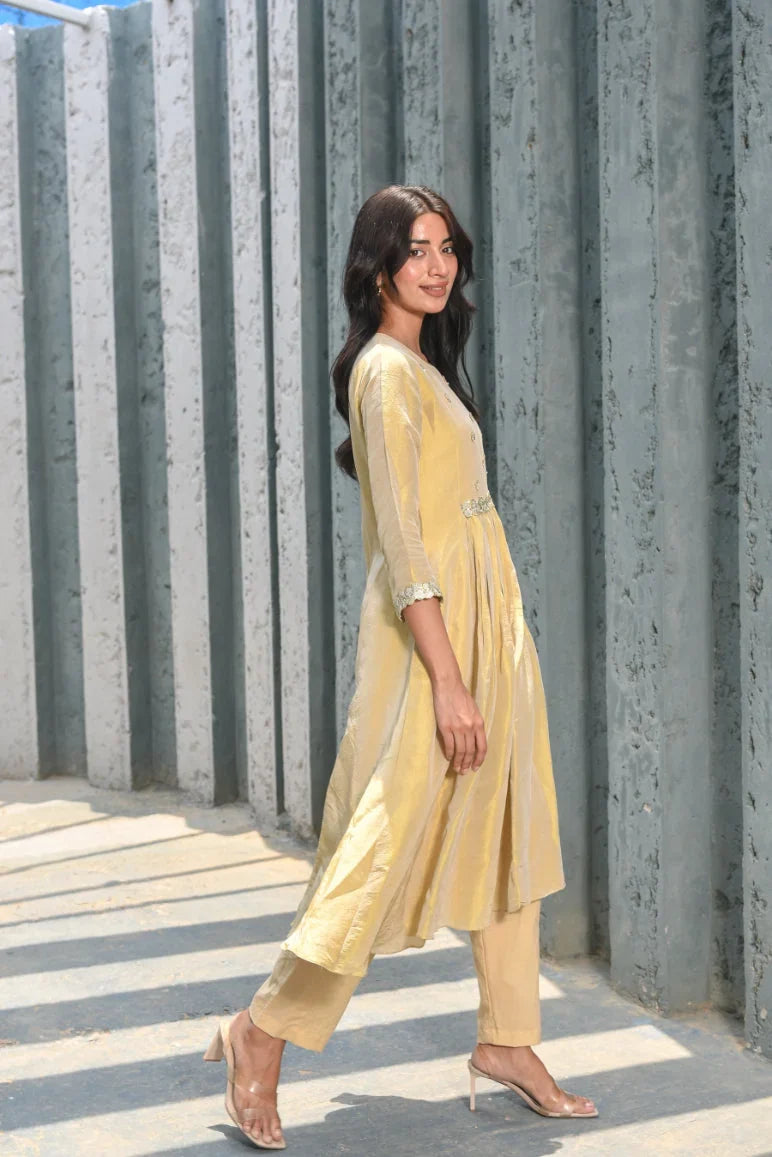


How to Accessorise Your Kurta Set: Tips From Our Fitting Room
Updated: July 2026 | Written by: Saroj Jain Styling Team
Not sure which jewellery to wear with your new kurta set? You are not alone. At our JP Nagar boutique, accessorising questions come up in nearly every fitting. Clients walk in with a beautiful kurta set and no idea what earrings, footwear, or dupatta will pull it together. After helping hundreds of women get this right, here is what we have learned.

Key Takeaways
- Match jewellery metal to your kurta's embroidery colour, not the fabric colour.
- Heavy embroidered necklines need no necklace. Let the neckline do the work.
- Your dupatta drape changes the entire silhouette. Try at least 3 drapes before deciding.
- Footwear height should match the hemline, not the occasion.
1. Start With the Neckline Before You Pick Any Jewellery
This is the first thing we tell every client in the fitting room. Look at your neckline before you open the jewellery box.
If your kurta has a high neck with heavy embroidery, you do not need a necklace. A pair of statement earrings is enough. Adding a necklace on top of an already busy neckline makes the outfit look cluttered.
If your neckline is deep or plain, that is where a necklace shines. We recommend a choker or a mid-length pendant for V-neck kurtas. Round necks work well with shorter chains that sit just above the fabric.
2. Match the Metal to the Embroidery, Not the Fabric
A question we hear every week: "Should I wear gold or silver with this?"
Here is the rule we use at the boutique. Ignore the fabric colour. Look at the embroidery thread. If the thread is gold zari, wear gold jewellery. If the thread is silver or white resham, wear silver or diamond jewellery. If the embroidery has both, pick the dominant one.
This one rule solves 90% of accessorising confusion. A pink kurta with gold zari work takes gold earrings beautifully. A green kurta with silver gota work looks best with silver. The fabric colour is secondary.
3. The Dupatta Is Your Most Underrated Accessory
Most women treat the dupatta as an afterthought. We treat it as the centrepiece.
A well-draped dupatta changes the entire proportion of your outfit. Try draping it over one shoulder for a classic look. Pin it at both shoulders like a cape for something more structured. Let it hang loose from one elbow for a relaxed, effortless feel.

We keep safety pins and dupatta clips at every fitting station. The difference between a pinned dupatta and an unpinned one is the difference between looking put-together and looking like you rushed out the door.
4. Your Footwear Should Match the Hemline
This is not about comfort. It is about proportion.
Straight-cut kurtas and ankle-length pants look best with flats or low-block heels. The clean line from hip to ankle does not need interruption. Sharara sets and flared palazzos, on the other hand, need height. A 2-to-3-inch heel lifts the fabric off the floor and gives you a longer silhouette.
We tell clients to bring their footwear to the fitting. The hemline we mark on the alteration depends entirely on the heel height you will actually wear.
5. When in Doubt, Take One Thing Off
Coco Chanel's old rule about removing one accessory before leaving the house still works. We see this mistake most often with bridal party guests. They add the heavy earrings, the maang tikka, the bangles, the rings, the potli bag, and suddenly the outfit disappears under all the extras.
Pick two statement pieces. That is it. If your earrings are dramatic, keep the rest minimal. If your necklace is the hero, wear small studs. The outfit should be what people notice first.
Quick Comparison: Which Jewellery With Which Neckline
| Neckline Type | Necklace | Earrings | Avoid |
|---|---|---|---|
| High round neck with embroidery | Skip entirely | Chandbalis or jhumkas | Heavy chokers that fight the neckline |
| Deep V-neck | Layered chains or pendant | Small studs or drops | Statement earrings with a statement necklace |
| Mandarin collar | Skip | Long jhumkas | Anything that sits at the collarbone |
| Sweetheart or boat neck | Choker or collar necklace | Medium studs | Long chains that break the neckline curve |
What We Tell Every Client Before They Leave
Accessorising is not about following rules. It is about knowing which rules you can break.
The only non-negotiable at our boutique is fit. Jewellery can be swapped. Dupatta drapes can be changed. But if the kurta does not fit your shoulders right, nothing else will look good. Get the fit right first. Everything else follows.
Still not sure what works with your outfit? WhatsApp us a photo of your kurta set. We will tell you exactly what jewellery to pair with it. No charge. We do this for our clients every day.
FAQs
Can I wear silver jewellery with a gold-embroidered kurta?
We recommend sticking to the embroidery colour. Gold thread wants gold jewellery. Mixing metals works if the embroidery itself is mixed, but if it is pure gold zari, silver will clash.
What footwear works with a straight-cut kurta and churidar?
Flat juttis or low-block heels work best. The churidar gathers at the ankle, so you want footwear that sits close to the foot without adding bulk. Avoid anything with ankle straps that break the line.
Should I wear a maang tikka with a simple kurta set?
Yes, but keep it light. A small single-stone maang tikka adds a festive touch without overwhelming a simple kurta. Skip the heavy bridal-style tikkas. They look out of place without a heavier outfit to anchor them.
How many bangles should I wear?
We recommend 6 to 8 bangles per wrist for most occasions. More than 10 starts to feel costume-like. For office wear, 2 to 4 thin bangles or a single statement kada is enough.
Can I skip the dupatta entirely?
You can. A well-fitted kurta set with the right jewellery and footwear works without a dupatta. But we always suggest trying at least one drape before you decide. The dupatta often adds the structure that makes the outfit feel complete.
Browse Our Kurta Set Collection
Need personalised advice? Book a consultation or WhatsApp us.