
Haldi Ceremony Dress Code And Outfit Ideas
Updated: August 2026 | Written by: Saroj Jain Styling Team | Reviewed by: Saroj Jain Boutique Team
Haldi ceremony dress code and outfit ideas should begin with one practical rule: wear something festive enough for photographs, but comfortable enough for turmeric, heat, dancing, and sitting on the floor. Yellow is traditional, not compulsory. Orange, pink, green, coral, peach, and bright prints all work when the family has no strict theme.[1][3]
At our JP Nagar 5th Phase fitting room, the outfits that perform best are the ones clients can sit cross-legged in without adjusting every few minutes. Bengaluru’s daytime warmth also makes breathable layers a better choice than heavy silk or velvet.[2][4]
Choose secure necklines, covered waistlines, manageable dupattas, and footwear with grip. Haldi is a moving ceremony, not a still photograph.
Quick answer: For most guests, choose a washable cotton, mulmul, linen, cotton-silk, or light georgette outfit in yellow, orange, pink, green, peach, or a bright print. Select a kurta set, simple saree, light Anarkali, or easy dress. Pin the dupatta, cover the waist, wear flat non-slip footwear, and avoid expensive silk, velvet, dense embroidery, and anything that needs constant fixing.[1][2][4]
- The Haldi dress code in simple terms
- Colours beyond yellow
- Best fabrics for turmeric and heat
- Silhouettes that stay secure
- Practical styling for rituals
- Saroj Jain outfit picks
- Outfit comparison
- Body type and silhouette guide
- What to avoid
- Frequently asked questions
- Visit our JP Nagar boutique
The Haldi Dress Code in Simple Terms
The usual Haldi dress code is bright, comfortable, daytime Indian wear. Yellow remains the easiest choice because it reflects the turmeric ritual, but guests do not need to dress in identical shades.[1][3]
For a guest, the right level of dress is festive but washable. A light kurta set or printed dress can be smarter than a heavy lehenga when the ceremony includes dancing, floor seating, and direct turmeric application.
If you are close to the bride or groom, ask whether the family has chosen a colour palette. Coordinating is considerate. Matching the couple exactly is not required.
Yellow Is Traditional. It Is Not Compulsory.
Yellow, mustard, marigold, and saffron are the safest thematic choices. They also make small turmeric marks less obvious than very pale colours.[1][3]
Orange gives the same festive warmth. Pink and coral add softness. Lime or emerald green creates contrast. Purple can work when balanced with gold, yellow, or a bright floral print.
White, cream, and ivory are possible only when you accept visible staining. Black, navy, and deep maroon can show turmeric unevenly, especially around folds and embroidery.[5][9]
Choose Fabric for Heat, Movement, and Stains
Cotton and mulmul: Breathable, easy for daytime rituals, and practical when you expect direct turmeric contact.
Linen and linen blends: Cool and relaxed. Choose a lining when the weave is sheer or when you need more structure.
Chanderi and cotton-silk: A dressier finish without the weight of velvet or thick silk. Keep embellishment light.[4][5]
Georgette and chiffon: Fluid and easy to move in, but use a secure lining and a manageable dupatta. Treat any stain quickly.
Use caution with silk, velvet, brocade, satin, and heavy zardozi: Turmeric can be difficult to remove, while dense embroidery can trap paste. These fabrics are better for a controlled reception than a hands-on Haldi ritual.[1][8][9]
Secure Silhouettes Beat Fussy Outfits
Choose a tucked-in kurta, a one-piece dress, or a set with a covered waistline. These options reduce exposed fabric while you sit, bend, dance, or participate in rituals.
High-neck and narrow-strap blouses offer more security than loose, low-cut designs. If you wear a saree, use a firm petticoat, secure pleats, and pins at the shoulder and waist.
For lehengas, select a comfortable waistband and a shorter hem that will not catch on outdoor flooring. A lighter skirt is easier to manage than layers of stiff net.
Make the Outfit Ritual-Ready
Pin the dupatta at both shoulders. Keep one short front drape instead of a long loose loop. This prevents the fabric from dipping into turmeric bowls or catching on chairs.
Wear flat juttis, sandals, or shoes with a non-slip sole. Haldi venues often involve grass, tiles, uneven outdoor surfaces, and quick movement.[2]
Choose small hoops, studs, or lightweight jhumkas. Avoid long necklaces and bangles that interfere when you apply turmeric or hold a plate.
Keep hair in a braid, low bun, or secure ponytail. At our boutique, clients often prefer styles that stay in place while dancing rather than elaborate hair that needs repeated fixing.
Bengaluru Comfort Matters
For a warm outdoor Haldi in Bengaluru, keep the base layer breathable. Avoid thick linings unless the garment is sheer or needs shape.
Choose sleeves that allow arm movement and hemlines that clear the floor. You should be able to sit cross-legged, stand quickly, and walk without lifting the outfit repeatedly.
Our JP Nagar 5th Phase clients often test an outfit by sitting, reaching forward, and turning before buying. That small test catches slipping necklines, tight armholes, and awkward hems early.
Saroj Jain Outfit Picks
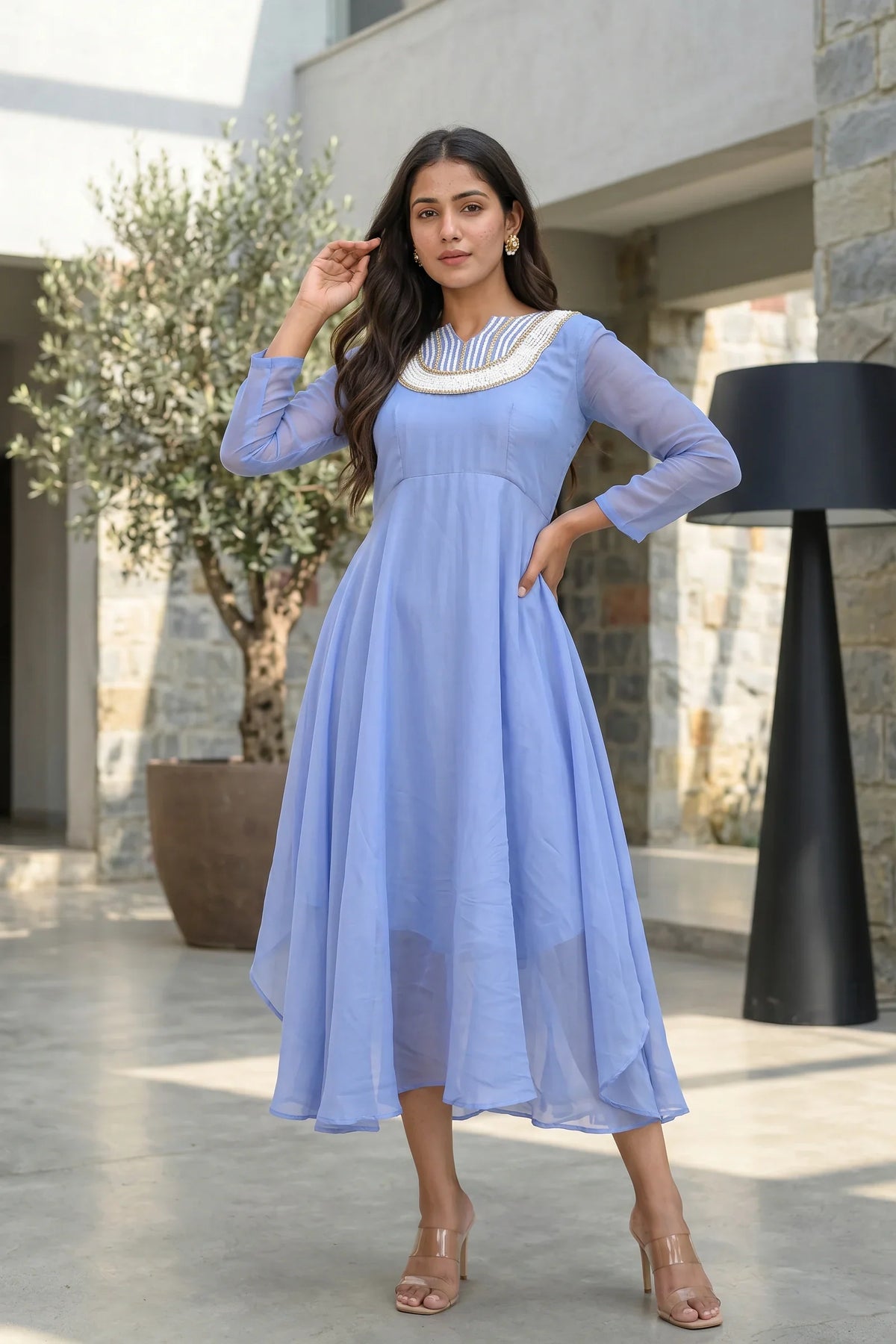
Saroj Jain pick: Baby Blue Asymmetrical Dress

Price: ₹2,336.19
Why it works: A one-piece silhouette reduces dupatta management and gives you easy movement during a relaxed Haldi gathering. The blue offers a fresh alternative when yellow is not compulsory.
Best for: Guests attending a modern daytime function or a smaller family ceremony.
Style with: Gold studs, a slim bracelet, and comfortable flat sandals.
Avoid if: The family has specified traditional Indian wear or you expect heavy direct turmeric contact on pale fabric.
Shop the Baby Blue Asymmetrical Dress
Saroj Jain pick: Cut Work Kurti

Price: ₹3,560.49
Why it works: Orange sits naturally within the Haldi palette and is more forgiving than white or ivory. A kurti is practical for sitting, eating, and joining rituals.
Best for: Guests who want a traditional base with a lighter, easygoing feel.
Style with: Straight trousers, small gold earrings, and flat juttis. Add a lightweight dupatta only if needed.
Avoid if: You prefer completely covered fabric around cut-work areas during direct turmeric application.
Saroj Jain pick: Emerald Green Heavy Work Anarkali Dress With Dupatta

Price: ₹6,676.89
Why it works: Emerald green gives strong festive contrast when the dress code allows colours beyond yellow. The Anarkali shape provides coverage and movement without requiring a saree drape.
Best for: A bridesmaid or guest attending the photo-heavy part of the function before active turmeric rituals.
Style with: Minimal earrings, secure hair, and low flat footwear. Pin the dupatta at both shoulders.
Avoid if: You will be directly covered in turmeric and cannot accept possible staining on heavy work.
Shop the Emerald Green Heavy Work Anarkali Dress With Dupatta
Saroj Jain pick: Floral Mirage Satin Afghani Dress

Price: ₹4,450.89
Why it works: The relaxed Afghani shape gives room for movement and the floral print breaks away from a single-colour Haldi look.
Best for: Guests attending a casual, colourful, or contemporary Haldi function.
Style with: Small hoops, a compact clutch, and flat sandals with grip.
Avoid if: The ceremony involves heavy turmeric contact, since satin needs more careful stain handling than washable cotton.
Shop the Floral Mirage Satin Afghani Dress
Which Outfit Fits the Function?
| Outfit | Fabric or finish | Festive scale | Price |
|---|---|---|---|
| Baby Blue Asymmetrical Dress | One-piece dress | Light and contemporary | ₹2,336.19 |
| Cut Work Kurti | Orange cut-work kurti | Moderate and traditional | ₹3,560.49 |
| Emerald Green Heavy Work Anarkali Dress With Dupatta | Heavy-work Anarkali | High and ceremonial | ₹6,676.89 |
| Floral Mirage Satin Afghani Dress | Printed satin dress | Moderate and contemporary | ₹4,450.89 |
Body Type and Silhouette Matrix
| Build | Useful silhouette | Styling move |
|---|---|---|
| Petite | Shorter kurti, streamlined Anarkali, or one-piece dress | Keep the hem clear and avoid too many heavy layers. |
| Tall | Long Anarkali, Afghani dress, or saree with a defined drape | Use a visible border or contrasting dupatta to balance length. |
| Curvy | Structured kurta set or gently flared Anarkali | Choose comfortable armholes and a covered waistline. |
| Lean | Layered kurta, printed dress, or light Anarkali | Use print, texture, or a soft dupatta for added shape. |
What to Avoid
- Do not wear your most expensive silk or velvet outfit when turmeric contact is expected.[8][9]
- Do not choose a long loose dupatta that can dip into bowls or catch underfoot.
- Do not wear slippery heels on grass, tile, or uneven outdoor flooring.
- Do not select a neckline, blouse, or waistline that needs repeated adjustment.
- Do not over-layer in warm Bengaluru weather.[2]
- Do not use heavy jewellery that restricts your arms during rituals.
- Do not wash turmeric stains with hot water first. Start with cold water and follow the care label.[9]
Frequently Asked Questions
Is yellow compulsory for a Haldi ceremony?
No. Yellow is traditional, but orange, pink, green, peach, coral, and bright prints are suitable when the family has not set a strict palette.[1][3]
What to wear to a Haldi ceremony as a guest?
Choose a light kurta set, simple saree, comfortable Anarkali, printed dress, or easy lehenga. The best choice allows you to sit, move, and participate without constant adjustments.
Which haldi function dress for women is most practical?
A washable kurta set or a one-piece dress is usually easiest. A light Anarkali works when you want more festive presence, while a saree needs stronger drape control.
Are yellow Haldi outfit ideas limited to sarees and lehengas?
No. Try a yellow kurta set, mustard Anarkali, orange printed dress, floral co-ord, or a simple cotton saree. The colour matters less than comfort and secure construction.
Can I wear white, ivory, or pale pink?
Yes, if the family permits it and you accept staining. Very pale clothing shows turmeric clearly, so it is not the safest choice for an active ritual.[5][9]
What fabrics handle turmeric best?
Cotton, mulmul, linen, cotton-silk, and light washable blends are practical. Heavy silk, velvet, thick brocade, and dense embroidery are harder to clean and less comfortable in heat.[1][4][8]
How do I keep my outfit secure during dancing and rituals?
Pin the dupatta at both shoulders, choose a covered waistline, wear a supportive blouse or inner layer, and select flat footwear with grip. Test the outfit by sitting and reaching before the event.
Ready to Find Your Fit? Visit Our JP Nagar Boutique
Visit SAROJ JAIN at 57/1, 1st Cross Rd, opposite to Iyengar's Bakery, 5th Phase, Dollar Layout, JP Nagar Phase 5, Bengaluru, Karnataka 560078.
Bring the invitation, share the venue setting, and tell us whether you will join the turmeric ritual or attend as a guest. We will help you choose the right colour, fabric, drape, and footwear for the actual function.
WhatsApp the Styling Team View the Lookbook Shop Collections Book a Boutique Meet
For colour, comfort, and a fit that stays secure through the ceremony, use these haldi ceremony dress code and outfit ideas before you shop.