
How to Coordinate Family Ethnic Wear Outfits
How to Coordinate Family Ethnic Wear Outfits
Updated: August 2026
Written by: Saroj Jain Styling Team
Reviewed by: Saroj Jain Boutique Team
Families walk into our JP Nagar boutique with one shared worry: how do we look coordinated without looking like a uniform? It is a fair question. Identical outfits can read flat in photos, while a loose, mismatched family picture looks careless. The answer sits in the middle. We coordinate around one shared colour and let every person keep their own silhouette and comfort. This guide shows you exactly how we do it.
Quick Summary
- Pick one anchor colour and two supporting colours, then let each member vary the shade.
- Coordinate silhouettes loosely, not identically, so everyone keeps their own style.
- Match fabric weight to the time of day: cotton for mornings, silk and zari for evenings.
- Comfort beats a perfect match, especially for kids and grandparents.
How Do You Pick a Coordinating Colour Palette?
Start with one anchor colour that flatters the person the photos will focus on, usually the bride, the couple, or the eldest family member. Then add two supporting colours in the same warmth. At our boutique we often build family palettes around blush pink, beige, and a soft gold for daytime, or teal, ivory, and maroon for evening functions. One anchor keeps the group tied together while the supporting shades give everyone room to breathe.
What Fabric Works Best for a Family Look?
Match fabric to the time of day, not just the colour. For a daytime haldi or morning puja, cotton, chanderi, and light georgette let everyone breathe. For an evening reception, silk, zari, and tissue carry the formality. We dress kids and grandparents in the lightest fabric of the palette because they move more and overheat faster.
Matchy, Coordinated, or Complementary?
Three ways to tie a family together, and each has a place depending on the size of the group and the function.
| Approach | What it looks like | Best for | Watch out for |
|---|---|---|---|
| Exact match | Same colour and fabric on everyone | Small families, couple looks | Can read flat in large groups |
| Coordinated | Same colour family in different shades | Weddings and festive functions | Needs one clear anchor colour |
| Complementary | Contrasting colours tied by a common thread | Large families, mixed ages | Needs a styling eye to avoid clashes |
How Do You Style Each Member Differently?
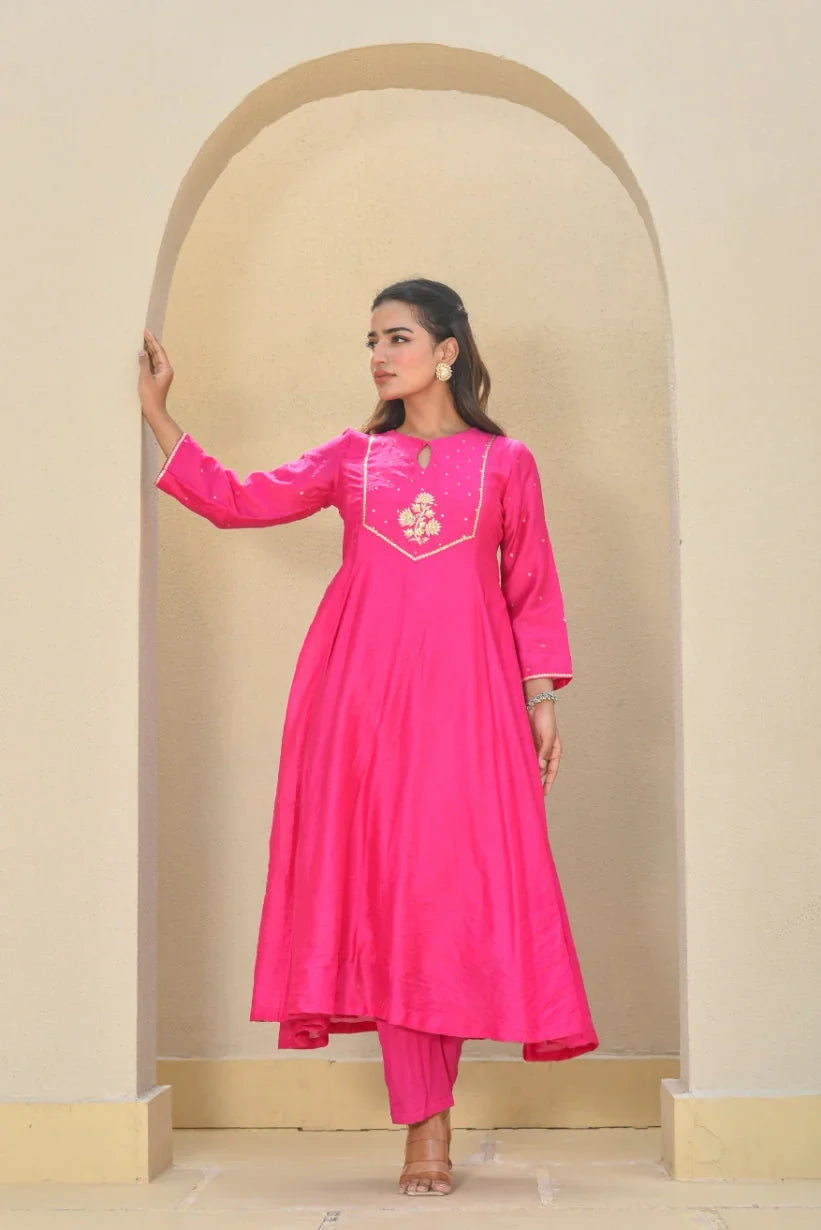
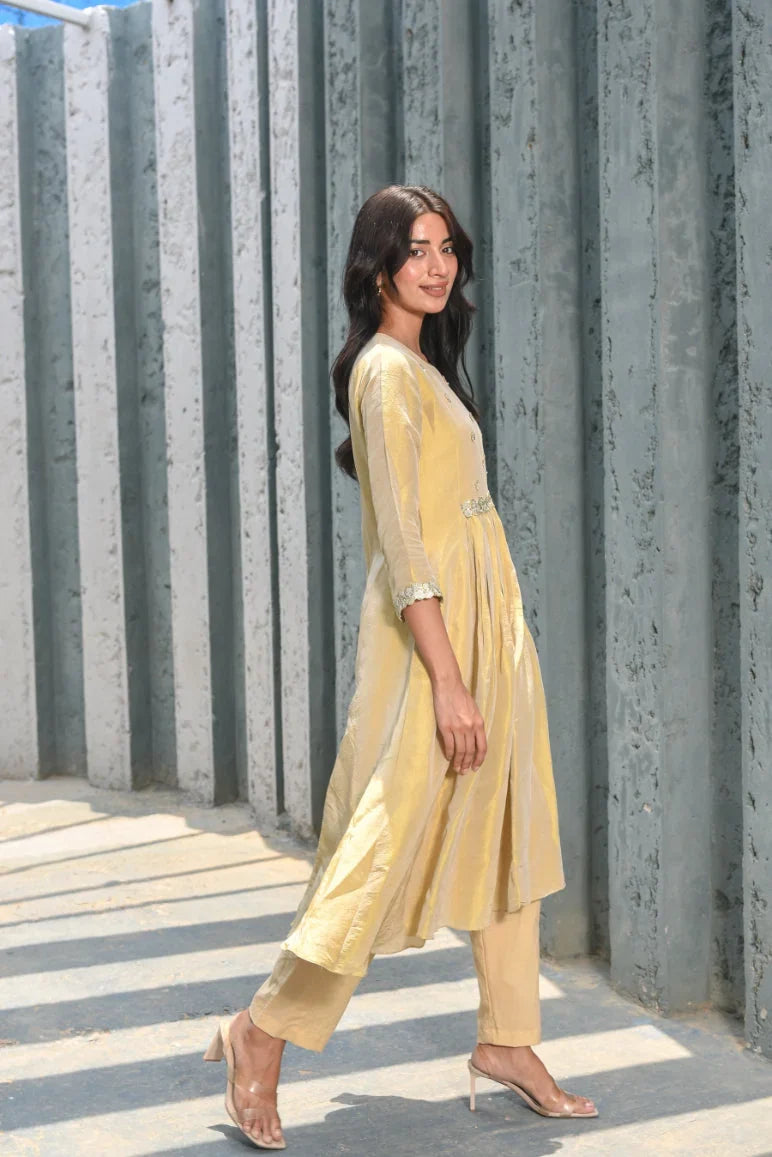
Keep the palette shared but the shapes personal. Men in a kurta or bandhgala, women in an anarkali, lehenga, or saree, kids in lighter kurta sets and lehenga sets. Vary the embroidery weight too, heavier on the couple, lighter on everyone else. The shared colour does the work of tying the photo together.
Saroj Jain pick: Beige Zari Silk Anarkali Set

Price: Rs. 2,781
Why it works: A beige anchor with zari detail flatters most skin tones and pairs easily with gold, blush, or maroon support shades.
Best for: The mother of the bride or an elder family member.
Style with: Gold jhumkas, a soft dupatta drape, and minimal footwear.
Saroj Jain pick: Baby Pink Bandhej Kurta Set

Price: Rs. 4,673
Why it works: Baby pink bandhej reads softly festive and sits well inside a blush or beige family palette.
Best for: A sister, cousin, or younger family member.
Style with: Silver or pearl accents and a simple clutch.
What Should You Avoid?
- Dressing everyone in one heavy silk for a daytime function. It looks stiff and feels hot.
- Mixing gold and silver metallics without intent.
- Over-accessorizing children. One small piece is enough.
- Forcing a shy family member into a colour they dislike. A reluctant face shows in every photo.
Frequently Asked Questions
Can we coordinate family outfits on a budget?
Yes. Reuse one anchor colour and vary the silhouettes. You do not need new matching sets for everyone, a shared shade is often enough to tie the group together.
What colour should the mother of the bride wear?
A deeper shade of the family palette that flatters her, often maroon, teal, or rani pink for evening functions, in a fabric that carries a little structure.
How do we coordinate a large family?
Use a complementary palette with one common thread, such as a shared gold accent, rather than exact matching. This gives everyone room while keeping the group connected.
Do kids need to match the adults?
Not exactly. Keep them in the same colour family but in lighter, softer fabrics like cotton and chanderi so they stay comfortable through a long day.
Can the boutique help us coordinate?
Yes. Book a consultation and we build a palette and silhouettes for the whole family, from kids to grandparents, so everyone arrives ready.
Still deciding? Browse family-friendly anarkalis and kurta sets at sarojjain.com, view our recent work on the lookbook, or message us on WhatsApp for a styling consultation.